

On this page
Nara Travel Guide: Ancient Cradle of Japan, Sacred Deer & Timber Giants
Long before Kyoto rose as the imperial seat, Nara (奈良)—then known as Heijō-kyō—served as Japan’s first permanent capital from 710 to 784 AD. Prior to this historic shift, custom dictated that imperial capitals be abandoned upon the death of an emperor to avoid spiritual contamination. By establishing Heijō-kyō, imperial leaders modeled a permanent bureaucratic city directly on the grand, symmetrical grid of Tang Dynasty Chang’an (modern-day Xi'an). It was here during the eighth-century Nara Period that Buddhism became institutionalized as the spiritual protector of the state, giving birth to monumental wooden architecture, bronze casting, classical literature, and the philosophical foundations of Japanese culture.
Today, Nara Prefecture presents a tranquil, grounded contrast to the hyper-dense neon grids of nearby Osaka and the high-volume crowds of Kyoto. Set within an emerald basin surrounded by rolling, forested hills, Nara is celebrated for its historic parklands where over a thousand wild, free-roaming sika deer wander among centuries-old stone lanterns and timber pavilions. Beyond the iconic central temple circuit of Nara Park lies a deeper rural heartland: the preserved merchant townhouses of Naramachi, the ancient eighth-century pagodas of Yakushi-ji and Tōshōdai-ji, the misty primeval trails of the Yamanobe-no-Michi, and the sacred mountain sanctuaries of Yoshino.
Navigating Nara: Key Geographic Sectors
While most day-trippers concentrate strictly on the deer and temples immediately surrounding Nara Park, the prefecture rewards travelers who venture further into its ancient plains and southern mountains:
| Sector | Primary Station Hubs | Atmosphere & Character | Key Highlights |
|---|---|---|---|
| Nara Park & Sacred Core | Kintetsu-Nara / JR Nara | Expansive parkland lawns, ancient primeval forest, monumental wooden halls, freely wandering sacred sika deer. | Tōdai-ji & Great Buddha, Kasuga Taisha, Kōfuku-ji, Mount Wakakusa, Isui-en Garden. |
| Naramachi & Downtown | Kintetsu-Nara / JR Nara South | Preserved Edo and Meiji merchant townhouses (machiya), craft sake microbreweries, artisanal cafés, hidden shrines. | Gango-ji, Naramachi Koshi-no-Ie (Lattice House), Harushika Sake Brewery. |
| Nishi-no-Kyō (Western Suburbs) | Nishinokyo Station (Kintetsu) | Quiet agricultural plains, sprawling temple courtyards, eighth-century original pagodas. | Yakushi-ji, Tōshōdai-ji, Heijō Palace Site Historical Park. |
| Asuka & Southern Heartland | Asuka / Yamato-Yagi | Ancient megalithic stone tombs, terraced rice paddies, quiet country cycling routes, earliest imperial ruins. | Ishibutai Kofun, Takamatsuzuka Tomb, Asuka-dera, Hōryū-ji (Ikaruga). |
| Yoshino Mountain Region | Yoshino Station (Kintetsu) | Spiritual mountain wilderness, Shugendō ascetic trailheads, Japan’s most famous spring cherry blossom ridges. | Mount Yoshino (30,000 sakura trees), Kinpusen-ji, Yoshimizu Shrine. |
Top Things to Do in Nara
1. Stand in Awe of the Great Buddha at Tōdai-ji
Commissioned in 743 AD by Emperor Shōmu to protect the realm against disease, drought, and political rebellion, Tōdai-ji (Eastern Great Temple) was the administrative head of all provincial Buddhist temples across Japan. Its central sanctuary, the Daibutsuden (Great Buddha Hall), is one of the world's largest freestanding wooden structures—and the current building, rebuilt in 1709, is actually one-third smaller than the eighth-century original. Entering through the monumental Nandaimon (South Great Gate), visitors pass two eight-meter-tall wooden Kongōrikishi guardian statues carved in 1203 by master sculptors Unkei and Kaikei, standing in fierce dynamic postures with veins bulging through their timber skin.
Inside the Daibutsuden sits the monumental Daibutsu (Rushana Buddha), an extraordinary 15-meter-tall bronze sculpture weighing over 500 metric tons. Cast from copper, tin, and gold, the Buddha’s right hand is raised in the semui-in mudra, granting reassurance and freedom from fear. Directly behind the statue stands a massive wooden support pillar with a hollow opening carved through its base; Japanese folklore holds that anyone who can successfully squeeze their body through the aperture is guaranteed enlightenment and safe passage into the Buddhist afterlife.
2. Walk the Mossy Lantern Paths of Kasuga Taisha
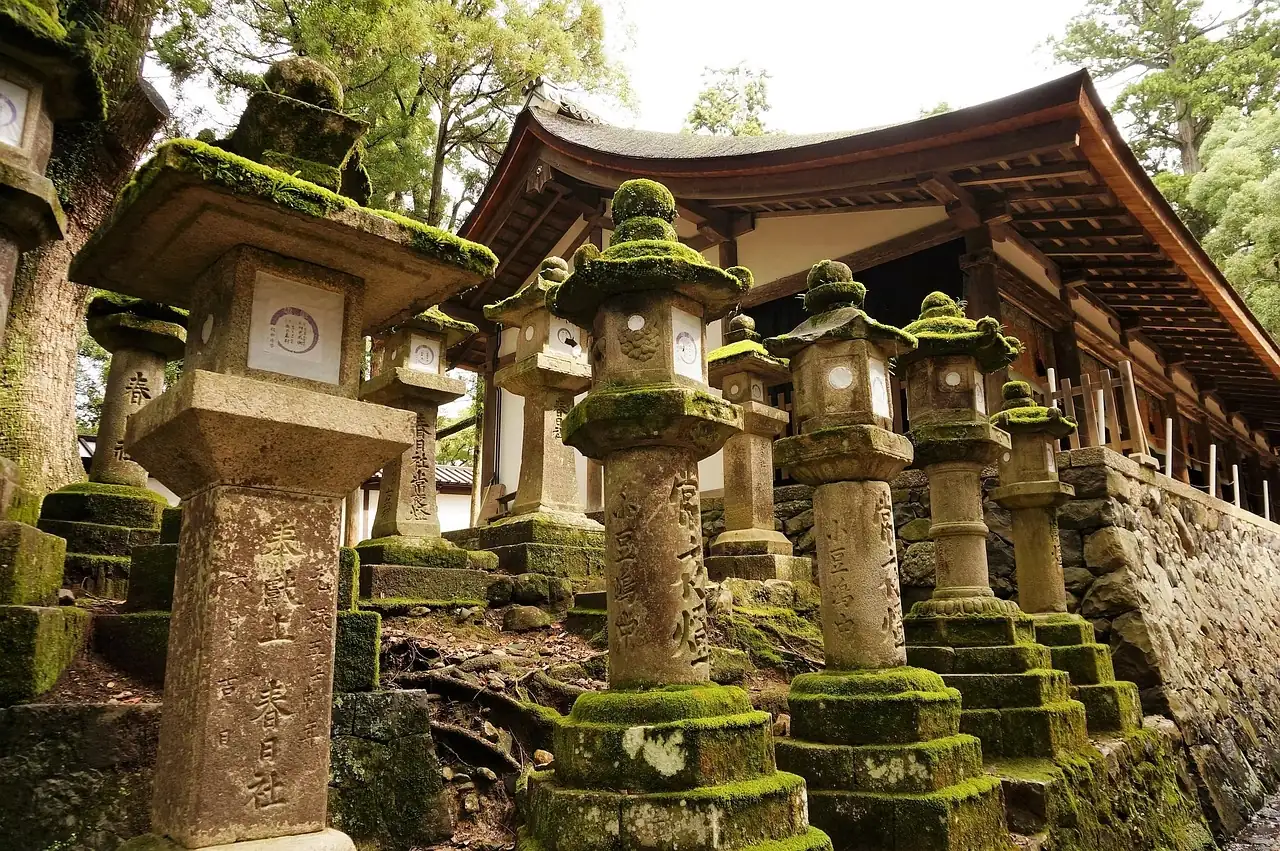
Founded in 768 AD by the powerful Fujiwara clan, Kasuga Taisha is Nara’s most revered Shinto shrine, dedicated to deities tasked with guarding the imperial capital. Nestled at the foot of the sacred, primeval forest of Mount Kasugayama—where hunting and tree felling have been strictly forbidden for over a millennium—the shrine approach is flanked by over two thousand moss-draped stone lanterns (ishi-dōrō) donated by worshippers over centuries. An additional one thousand bronze hanging lanterns (tsuridōrō) hang from the vermilion eaves of the inner corridors. Twice a year during the Setsubun Mantōrō (February) and Chūgen Mantōrō (August) festivals, all three thousand stone and bronze lanterns are lit simultaneously with flickering beeswax candles, casting an unforgettable golden glow across the forest.
3. Encounter the Sacred Sika Deer of Nara Park
Over 1,200 wild sika deer roam freely across the 660 hectares of Nara Park. According to Shinto legend, when Kasuga Taisha was founded, the god Takemikazuchi arrived at the capital riding upon a sacred white deer; since then, the deer have been venerated as divine messengers of the gods (shinroku) and protected by imperial decree. Today, they are designated National Natural Monuments. Visitors can purchase stacks of shika-senbei (wheat-and-rice-bran deer crackers, officially regulated for their nutritional safety) from carts across the park. The deer have famously learned to bow their heads politely to tourists before receiving a treat. Traveler note: While accustomed to humans, the deer are wild animals; keep food sealed inside bags and avoid teasing them, especially during the autumn mating season when stags can become aggressive.
4. Ascend Mount Wakakusa for Golden Hour Views
Rising directly behind Kasuga Taisha and Tōdai-ji, Mount Wakakusa (Wakakusayama) is a grassy 342-meter hill that offers sweeping panoramic views across the Nara basin. The walking trail to the plateau summit takes roughly thirty minutes through sloping lawns, providing a quiet escape from the tour groups clustered around the temple gates below. On the fourth Saturday of every January, the mountain is the stage for the dramatic Wakakusa Yamayaki festival, during which the dormant grasslands across the entire hillside are set ablaze in a towering wall of fire, accompanied by winter fireworks over the ancient temples.
5. Explore the Five-Story Pagoda of Kōfuku-ji
Originally relocated from Asuka in 710 AD as the tutelary temple of the Fujiwara family, Kōfuku-ji once encompassed more than 150 temple halls. Today, its defining architectural monument is the graceful Five-Story Pagoda (Gojū-no-tō). Standing at 50 meters tall, it is the second-highest historic timber pagoda in Japan, its dark cedar tiers reflecting across the willow-fringed waters of Sarusawa Pond below. Don't miss Kōfuku-ji’s National Treasure Museum, which houses an extraordinary collection of Nara and Kamakura-period Buddhist statuary, anchored by the world-famous eighth-century dry-lacquer statue of Ashura, depicted with three faces and six arms expressing deep psychological contemplation.
6. Wander the Timber Alleys of Naramachi
Located immediately south of Sarusawa Pond, Naramachi is the historic merchant quarter that developed around the grounds of Gangō-ji temple during the Edo and Meiji eras. The district is characterized by narrow flagstone lanes lined with dark wooden machiya featuring traditional narrow-slatted facades. Hanging beneath the eaves of homes and storefronts, you will spot bright red-and-white cloth amulets known as Migawari-zaru (Substitute Monkeys), believed to absorb illnesses and misfortune on behalf of household residents. Visit the Naramachi Koshi-no-Ie (Lattice House), a faithfully restored merchant home open free to the public, offering insight into traditional spatial heating, interior courtyards, and under-stair storage cabinetry.
7. Discover the World’s Oldest Wooden Buildings at Hōryū-ji
Located in the town of Ikaruga, a 20-minute train ride southwest of central Nara, Hōryū-ji was founded in 607 AD by Prince Shōtoku, the revered patron who championed Buddhism across Japan. In 1993, Hōryū-ji was designated Japan’s very first UNESCO World Heritage site. The temple's western precinct (Sai-in)—encompassing the central gate (Chūmon), the main Kondo hall, and the five-story pagoda—contains the oldest surviving wooden buildings on earth, constructed using ancient Japanese cypress (hinoki) timber that has withstood earthquakes, typhoons, and fires for over 1,400 years.
Nara Culinary Heritage: Ancient Terroir & Regional Flavors
As the cradle of classical Japanese civilization, Nara is the historical birthplace of many culinary staples, including green tea cultivation, commercial sake brewing, and noodle production. Its local specialties reflect preservation methods refined before modern refrigeration:
- Kaki-no-Ha Zushi (Persimmon Leaf Sushi): Nara’s most iconic regional specialty. Salt-cured mackerel (saba) or salmon (sake) is pressed firmly over seasoned sushi rice, then individually wrapped in wild persimmon leaves. The persimmon leaves contain natural tannins that inhibit bacterial growth, infusing the rice with a subtle botanical fragrance while keeping the fish tender for days. Unpeel the leaf before eating—the leaf is for preservation and aroma, not consumption.
- Miwa Somen: Regarded as the origin of all Japanese wheat noodles, somen production began in the Miwa region of Nara over 1,200 years ago. Hand-stretched until hair-thin using vegetable oil and aged in wooden warehouses, Miwa somen is celebrated for its firm, snappy texture. In hot summer months, it is served chilled over ice water with a light dashi-soy dipping sauce; in winter, it is served warm in a comforting broth known as nyumen.
- Yamato Tea (Yamato-cha): According to historical records, the Buddhist monk Kūkai brought tea seeds back from Tang Dynasty China in 806 AD and planted them in the Yamato highlands east of Nara. The region’s misty mornings, high elevation, and sharp day-night temperature swings produce green teas with deep vegetal sweetness and minimal astringency.
- Narazuke Pickles: Crisp seasonal gourds (such as white melon, cucumber, and ginger) preserved through a labor-intensive, multi-year process of continuous brining in fresh sake kasu (lees left behind from sake fermentation). The resulting pickles turn a dark mahogany amber, offering an intensely savory, sweet, and lightly boozy crunch that pairs cleanly with plain white rice and grilled fish.
- Artisanal Sake Tastings in Naramachi: Shorin-in and Shōryaku-ji temples in Nara are documented as the historical birthplaces of refined clear sake (seishu) production, developing yeast-starter methods in the 1400s. Drop by the historic Harushika Sake Brewery in Naramachi, where for around ¥500 you can participate in a guided standing tasting of five distinct seasonal junmai and daiginjo sakes, served in a commemorative ceramic glass you keep as a souvenir.
Transportation: Visiting Nara Smoothly
Nara is one of the easiest cultural destinations in Kansai to visit, but station selection makes a massive difference in walking time:
- Kintetsu-Nara Station vs. JR Nara Station:
- Kintetsu-Nara Station: The superior arrival hub. Exiting Kintetsu-Nara puts you within a 5-minute walk of Kōfuku-ji and the western gate of Nara Park. Trains run directly from Osaka-Namba (35 minutes on the Kintetsu Nara Line) and Kyoto Station (35 minutes on the Kintetsu Kyoto Express).
- JR Nara Station: Located roughly one kilometer west of the park. Arriving on the JR Yamatoji Line from Osaka Station (50 minutes) or the JR Nara Line from Kyoto requires an extra 15-to-20-minute uphill walk through commercial streets, or a quick local bus connection to reach the main temple grounds.
- IC Card Transit (Suica, Pasmo, ICOCA): All regional trains, Kintetsu lines, JR services, and local Nara Kotsu buses accept digital transit cards loaded into Apple/Google Wallets. Simply tap your smartphone across turnstiles without buying paper tickets.
- Bicycle Rentals: Outside the hilly forest approaches of Kasuga Taisha, central Nara and the Asuka valley are flat and exceptionally bike-friendly. Rental shops clustered around Kintetsu-Nara and Asuka stations offer electric-assist bicycles (mamachari), ideal for exploring rural temples like Yakushi-ji and Tōshōdai-ji.
Where to Stay in Nara: Accommodation Strategy
While 85% of tourists visit Nara purely as an afternoon day-trip from Kyoto or Osaka, staying overnight reveals the city’s true magic: walking through lantern-lit temple gates and misty deer parklands at dawn long after the tour buses have returned to Osaka.
| Neighborhood | Vibe & Advantages | Transit Access | Hotel Strategy |
|---|---|---|---|
| Kintetsu-Nara & Parkside | Direct park access, early morning deer walks, immediate access to covered shopping arcades. | Direct Kintetsu lines to Kyoto and Osaka-Namba. | Historic luxury ryokans, high-end design hotels, standard Japanese business hotels. |
| JR Nara Station Area | Modern urban conveniences, supermarket access, wide range of budget dining options. | Direct JR lines to Osaka and Kansai Airport connections. | High density of modern, efficient business hotels (including multiple central APAs), budget chain properties. |
| Naramachi (Old Quarter) | Atmospheric timber alleys, quiet residential streets, artisanal dining at your doorstep. | 10-minute walk south from Kintetsu-Nara. | Restored boutique machiya private vacation rentals, heritage guesthouses. |
Day Trips Across Nara Prefecture
1. Ikaruga: The Legacy of Prince Shōtoku
Located just southwest of the capital plain, the rural district of Ikaruga is anchored by Hōryū-ji, alongside its companion temples Hōki-ji (famed for its 8th-century three-story pagoda rising above rural vegetable plots) and Chūgū-ji, a serene nunnery housing a celebrated wooden statue of the Miroku Bosatsu (Maitreya Buddha), seated with one leg crossed in deep psychological grace.
2. Asuka: The Ancient Imperial Valley
Before Heijō-kyō, early Japanese clans ruled from the verdant valley of Asuka. Rent an electric bicycle from Asuka Station and ride along country lanes through terraced rice paddies to explore enigmatic megalithic monuments: the Ishibutai Kofun, a massive stone burial chamber constructed from granite blocks weighing hundreds of tons; and Asuka-dera, Japan’s oldest full-scale Buddhist monastery, housing an archaic 7th-century bronze Asuka Great Buddha cast in 609 AD.
3. Mount Yoshino (Yoshinoyama)
Rising in southern Nara Prefecture, Mount Yoshino is celebrated as Japan’s undisputed premier cherry blossom destination, blanketed with over thirty thousand native yamazakura trees. The mountain is historically divided into four elevation bands—Shimo (Lower), Naka (Middle), Kami (Upper), and Oku (Inner) Senbon—allowing the blossom canopy to bloom sequentially from bottom to top over three weeks in April. Mount Yoshino is also the sacred spiritual heart of Shugendō, a syncretic religion of mountain asceticism. Stand before the towering blue-skinned Zao Gongen guardian statues inside the monumental wooden prayer hall of Kinpusen-ji, a major pilgrimage destination for white-robed mountain practitioners (yamabushi).
Best Seasons to Visit Nara
- Spring (Late March to Mid-April): The temple precincts of Nara Park, the grounds of Himuro Shrine, and the slopes of Mount Yoshino explode with cherry blossoms. Mild, pleasant daytime weather averaging 16°C to 20°C (61°F–68°F), accompanied by seasonal temple treasure unveilings.
- Autumn (Late October to Late November): Perhaps the most visually stunning season to explore Nara. The expansive maple and ginkgo groves across Nara Park turn vivid hues of crimson and gold, framing the dark timber pagodas of Tōdai-ji and Kōfuku-ji. The annual Shōsōin Exhibition is held at the Nara National Museum in late autumn, displaying rare imperial treasures preserved in pristine condition since the eighth century.
- Winter (December to February): Cool, crisp, and peaceful, with daytime temperatures averaging 5°C to 10°C (41°F–50°F). Clear skies provide unobstructed views from Mount Wakakusa. Early mornings around Kasuga Taisha are quiet and atmospheric, culminating in the Wakakusa Yamayaki mountain-burning festival on the fourth Saturday of January.
- Summer (June to August): Humid and warm, with temperatures frequently reaching 33°C (91°F). However, summer evenings are enlivened by the magical Nara Tokae Lantern Festival in early August, when over twenty thousand glowing candles in glass cups are laid across the lawns and water basins of Nara Park, illuminating the night landscape.


 京都
 大阪
 兵庫
 三重
 和歌山
 滋賀