

On this page
Hiroshima Travel Guide: Resilience, Sacred Islands & Maritime Heritage
Few cities on earth carry the historical gravity of Hiroshima (広島). On August 6, 1945, at 8:15 AM, the detonation of the world’s first wartime atomic weapon reduced the city center to ash within seconds, killing an estimated 140,000 people by year's end and leaving behind what many scientists predicted would be an uninhabitable wasteland for decades. Instead of vanishing, Hiroshima rebuilt itself from its ashes with astonishing determination. Today, it stands as a thriving, vibrant regional capital defined by wide tree-lined boulevards, tranquil river delta canals, a celebrated food scene, and an international mission as an open city of peace.
Most travelers arrive expecting purely solemn memorials, only to be surprised by Hiroshima's buoyant, optimistic atmosphere. Beyond the hallowed grounds of the Peace Memorial Park lies a multifaceted prefecture extending along the calm, island-studded waters of the Seto Inland Sea: the floating vermilion torii gate of Miyajima, the historic sake breweries of Saijo, the winding cobblestone hillside stairs of Onomichi, and the world-renowned Shimanami Kaido cycling route. Positioned directly on the Sanyō Shinkansen mainline between Osaka and Fukuoka, Hiroshima is an indispensable stop on any comprehensive Japan route.
Navigating Hiroshima Prefecture: Core Geographic Sectors
Hiroshima Prefecture stretches from the rugged Chūgoku mountain spine down across a wide coastal delta into the Seto Inland Sea. Structurally, it divides into five key zones:
| Sector | Primary Station Hubs | Landscape & Atmosphere | Key Highlights |
|---|---|---|---|
| Hiroshima City Core | Hiroshima Station / Hondori | Wide modern river delta avenues, green memorial parklands, vintage streetcar network, bustling downtown shopping arcades. | Atomic Bomb Dome, Peace Memorial Park, Shukkei-en Garden, Hiroshima Castle, Okonomimura. |
| Miyajima (Itsukushima) | Miyajimaguchi (Ferry terminal) | Sacred mountainous island, wild friendly deer, historic waterfront Shinto shrines, primeval hiking trails. | Itsukushima Shrine & Great Torii, Mount Misen, Daishō-in Temple, Momijidani Park. |
| Kure Harbor | JR Kure Station | Naval shipyards, deep maritime industrial history, submarine docks, dry docks. | Yamato Museum, JMSDF Kure Museum (Iron Whale submarine), Alley Karasukojima. |
| Saijo Sake District | JR Saijo Station (Higashihiroshima) | Atmospheric brewery street, red-brick tasting storehouses, white lattice walls, pristine spring water wells. | Sakagura-dori (Sake Brewery Street), Kamotsuru, Kamoizumi, Saijo Sake Festival. |
| Onomichi & The Islands | JR Onomichi / Shin-Onomichi | Nostalgic hillside port, historic temple walk, retro cinema heritage, world-class island suspension bridges. | Shimanami Kaido cycle route, Senkō-ji Temple, Cat Alley, retro waterfront cafes. |
Top Things to Do in Hiroshima City & Beyond
1. Reflect at the Peace Memorial Park and Atomic Bomb Dome
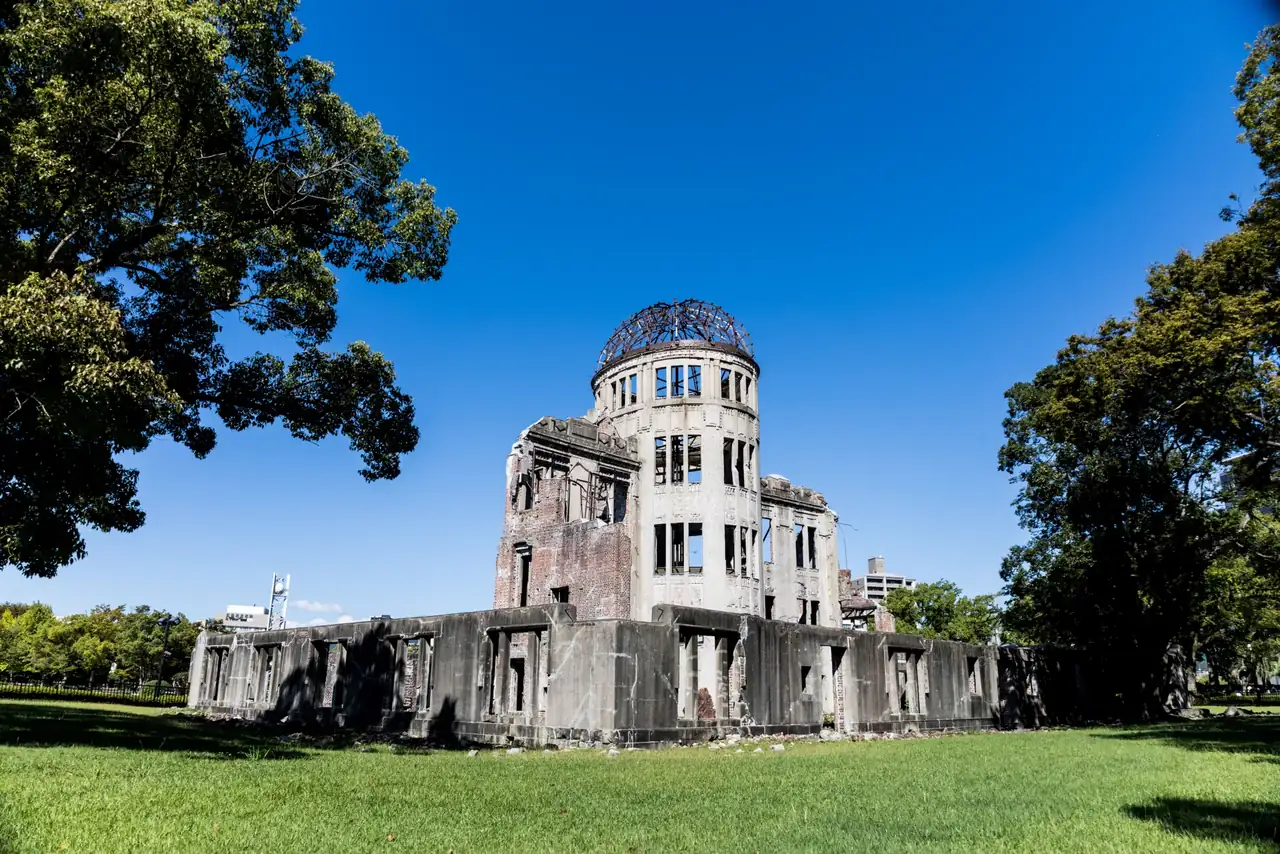
Situated on the triangular delta island between the Motoyasu and Honkawa rivers, the Peace Memorial Park (Heiwa Kinen Kōen) occupies what was once Nakajima, the thriving commercial heart of pre-war Hiroshima. The anchor of the grounds is the Genbaku Dome (Atomic Bomb Dome). Originally designed by Czech architect Jan Letzel in 1915 as the Hiroshima Prefectural Industrial Promotional Hall, the building was situated almost directly beneath the hypocenter of the blast. The vertical shockwave allowed its core brick structure and skeletal steel dome to miraculously remain standing while surrounding structures were pulverized. Preserved exactly as it looked on that morning, it stands as an uncompromising UNESCO World Heritage monument to the destructive reality of nuclear warfare.
Walk past the Cenotaph for the A-bomb Victims—an arched concrete saddle framing the Peace Flame, which has burned continuously since 1964 and will only be extinguished once all nuclear weapons on earth are dismantled. Nearby stands the Children's Peace Monument, dedicated to Sadako Sasaki, a young girl who developed radiation-induced leukemia and attempted to fold one thousand origami paper cranes in hopes of recovery; today, colorful display cases around the statue house millions of paper cranes sent by school children worldwide. Continue into the Hiroshima Peace Memorial Museum. Renovated with deep curatorial restraint, the museum displays personal artifacts—scorched tricycles, tattered children’s clothing, pocket watches frozen at 8:15, and written eyewitness accounts—presenting the human reality of the bombing with unflinching directness.
2. Cross to the Sacred Island of Miyajima (Itsukushima)
Located roughly 45 minutes southwest of central Hiroshima by train and ferry, the island of Itsukushima—popularly known as Miyajima (“Shrine Island”)—has been venerated as a sacred Shinto deity for millennia. To preserve the purity of the island's soil (where births, deaths, and burials were historically forbidden), Itsukushima Shrine was constructed on stilts over an inlet bay in 1168 by warlord Taira no Kiyomori. At high tide, the vermilion shrine corridors, prayer stages, and the monumental 16-meter-tall camphor-wood Great Torii Gate appear to float gracefully on the surface of the sea. At low tide, the sea recedes entirely, allowing visitors to walk across the damp tidal flats directly beneath the massive support pillars of the gate to inspect the barnacle-crusted timber and coins pressed into the grain by worshippers.
3. Ascend Mount Misen via the Ropeway or Primeval Trails
Towering 535 meters above Miyajima, Mount Misen is the sacred peak where the Buddhist monk Kūkai (Kōbō Daishi) practiced ascetic rituals in 806 AD. Take the Miyajima Ropeway or climb one of three hiking paths (the Daishoin course offers the finest stone stairs and mountain views; roughly 90 minutes) through pristine primeval forests of hemlock and fir. Near the summit sits the Reikadō (Hall of the Spiritual Flame), home to a sacred fire that has burned continuously for over 1,200 years; this exact flame was used to ignite the Peace Flame down in Hiroshima's Peace Park. From the granite observation deck at the peak, you are rewarded with sweeping panoramic views across the island-dotted waters of the Seto Inland Sea.
4. Discover the Hidden Treasures of Daishō-in Temple
Often overlooked by tourists rushing directly from the ferry to the floating torii, Daishō-in sits tucked into the wooded lower slopes of Mount Misen. As the head temple of the Omuro branch of Shingon Buddhism on Miyajima, the complex is packed with atmospheric details: a staircase lined with rotating prayer wheels containing Buddhist sutras (turning them grants the merit of reading the text), hundreds of stone Jizō statues wearing knitted wool beanies lining the forest paths, an underground cave path containing icons representing the 88 temples of the Shikoku Pilgrimage, and quiet tea terraces overlooking the sea.
5. Stroll the Miniaturized Landscapes of Shukkei-en Garden
Dating back to 1620, Shukkei-en (“Shrunken-Scenery Garden”) was created by tea master Ueda Sōko for the ruling Asano daimyo clan. The garden is an exquisite demonstration of circular stroll-garden design, meticulously sculpting miniature mountains, tea plantations, bamboo forests, valleys, and bridges around a central pond (Takuei-chi) filled with carp. Though heavily damaged in the 1945 blast, the garden was lovingly restored to its Edo-period splendor. Sit inside the rustic thatched-roof Seifū-kan tea pavilion or cross the arched granite Koko-kyo (Rainbow Bridge) during autumn when surrounding maples turn deep amber and scarlet.
6. Tour the Restored Hiroshima Castle (Carp Castle)
Originally constructed in 1589 by warlord Mōri Terumoto, Hiroshima Castle was a monumental flatland fortress surrounded by wide moats. Completely flattened in the atomic bombing, the five-story wooden main keep was reconstructed in 1958 with a dark wood-paneled exterior. Today, the keep functions as an engaging regional history museum displaying samurai swords, armor, and dioramas of pre-modern Hiroshima, with an open-air top deck looking out across the modern municipal sports arenas and office towers.
7. Cycle the World-Famous Shimanami Kaidō
Starting from the charming hillside port of Onomichi (an hour east of Hiroshima Station), the Shimanami Kaidō is a world-class 70-kilometer tollway and bicycle path that links Honshu to Shikoku across six lush islands in the Seto Inland Sea. Engineered with dedicated, gently graded bicycle approaches, the route takes riders across colossal suspension and cable-stayed bridges spanning cobalt-blue sea straits, winding through citrus orchards, fishing hamlets, and coastal beaches. High-grade road bikes, cross bikes, and e-bikes can be rented at Onomichi and dropped off at Imabari on Shikoku, or completed as an easier out-and-back day trip to the intermediate islands of Ikuchijima (famous for the whimsical Kosan-ji temple and lemon groves).
Hiroshima Culinary Identity: Layered Savory Mastery
Hiroshima has a distinct culinary pride. Unlike Osaka's mixed, quick-griddled street style, Hiroshima's cooking requires careful architectural layering and celebrates the abundance of the Seto Inland Sea:
- Hiroshima-Style Okonomiyaki: The definitive local soul food. Unlike Osaka style—where cabbage, batter, and ingredients are whisked together in a bowl before frying—Hiroshima okonomiyaki is constructed in rigorous, delicate vertical layers on a scorching iron teppan:
- A paper-thin crepe-like batter base is poured onto the grill.
- A towering mountain of shredded cabbage, bean sprouts, green onions, and strips of pork belly is piled on top.
- The stack is flipped and steamed under a metal cloche while fresh yakisoba (or udon) noodles are crisped separately on the grill.
- The vegetable-and-meat tower is placed directly over the fried noodles.
- The entire assembly is flipped onto a freshly fried egg, then coated in thick, sweet Otafuku sauce, sprinkled with aonori seaweed, and eaten straight off the griddle using a flat metal spatula (hera).
- Seto Inland Sea Oysters (Kaki): Hiroshima Prefecture produces over sixty percent of Japan's oysters, benefiting from calm, nutrient-rich currents fed by mountain rivers emptying into Hiroshima Bay. Eaten year-round, oysters are enjoyed raw with ponzu, battered and deep-fried as crunchy Kaki Furai, baked in their shells over charcoal grills on Miyajima's shopping street, or cooked with rice in savory dashi clay pots (Kaki-meshi).
- Momiji Manjū: The signature confection of Miyajima. Delicate buckwheat and rice-flour sponge cakes cast in the shape of a Japanese maple leaf, traditionally filled with sweet red bean paste (anko). Modern confectionery shops in Miyajima and Hiroshima Station now sell crisp deep-fried versions (Age-momiji) stuffed with custard cream, rich chocolate, matcha, or cream cheese.
- Hiroshima Tsukemen: A fiery local summer staple. Chilled, firm wheat noodles served with boiled cabbage, shredded cucumbers, char siu pork, and scallions, paired with a cold dipping broth laced with fiery red chili oil, roasted sesame seeds, and vinegar. Diners specify their chili heat level from 1 (mild) up to 20 or 30 (blazing).
- Anago Meshi (Conger Eel over Rice): A regional specialty perfected around the Miyajimaguchi ferry wharves. Freshwater-soft conger eel is grilled over charcoal with sweet soy glaze, sliced, and fanned out over steamed rice cooked in rich conger-bone dashi broth. The historic restaurant Ueno, operating outside the ferry docks since 1901, serves the gold standard.
Transportation: Mastering the Green Movers & Ferries
Hiroshima is unique among large Japanese cities because it relies on the nation's largest surviving vintage streetcar network rather than a subterranean subway:
- Hiroden Streetcars (Hiroshima Electric Railway): The heart of city transit. Operating eight distinct routes, the iconic "Hiroden" fleet features both modern, low-floor articulated trams and lovingly preserved historical rolling stock acquired from cities across Japan (including trams that survived the 1945 blast, known locally as "A-bomb Trams"). Flat fares operate within the city core (¥220), while Route 2 runs all the way from Hiroshima Station through the western suburbs directly to the Miyajimaguchi ferry port.
- Digital Transit Cards (IC Cards): Hiroden streetcars, regional JR lines, city loop buses, and Miyajima ferries accept digital Suica, Pasmo, and ICOCA cards loaded on your smartphone. When boarding a streetcar, simply tap your phone at the entrance door, and tap again at the driver’s terminal upon exiting.
- Hiroshima Sightseeing Loop Bus (Meipuru-pu): A convenient loop bus connecting Hiroshima Station directly to the Atomic Bomb Dome, Peace Memorial Park, Shukkei-en, and Hiroshima Castle. Buses run every 15 to 30 minutes and are completely free for holders of the JR Pass / JR West Regional passes.
- Ferries to Miyajima: Two competing ferry lines run every 10–15 minutes from Miyajimaguchi pier across the strait (10 minutes total crossing):
- JR West Ferry: Steers a slight detour course on daylight trips to provide passengers an unobstructed water-level photo angle of the floating Great Torii.
- Miyajima Matsudai Ferry: Runs the direct straight-line transit route.
Where to Stay in Hiroshima: Strategic Neighborhood Bases
| Neighborhood | Vibe & Atmosphere | Transit Access | Accommodation Strategy |
|---|---|---|---|
| Hiroshima Station Area | Modern commercial hub, high-rise department stores, clean transport interchanges. | Shinkansen bullet trains, JR regional lines, eastern Hiroden streetcar terminus. | Modern high-density Japanese business hotels (multiple central APAs), upscale railway towers, reliable chain properties. |
| Hondori & Hatchobori (Downtown) | High-energy pedestrian arcades, endless izakayas, walking distance to Peace Park. | Central Hiroden streetcar junctions, Astram monorail line. | Boutique urban lifestyle hotels, comfortable mid-tier business hotels, backpacker hostels. |
| Miyajima Island (Overnight) | Quiet, spiritual evening stillness; empty night shrine boardwalks once daytime day-trippers depart. | 10-minute ferry crossing to mainland rail. | High-end historic seaside ryokans (with kaiseki seafood banquets), traditional hot spring inns. |
Regional Day Trips from Hiroshima
1. Saijo: The Historic Sake Capital
Just 35 minutes east of Hiroshima Station on the JR Sanyo Line lies Saijo, recognized alongside Nada (Kobe) and Fushimi (Kyoto) as one of Japan’s premier historic brewing centers. Clustered along Sakagura-dori (Sake Brewery Street) are seven historic working breweries characterized by distinctive red-brick chimneys, black timber walls, and white diamond-patterned plaster. Walk between centuries-old houses like Kamotsuru (supplier to the Imperial Household) to taste mineral-rich well water and sample fresh, unfiltered seasonal sakes.
2. Kure: Imperial Naval History
A 35-minute express train south of Hiroshima sits Kure, historically one of the largest naval stations of the Imperial Japanese Navy where the colossal battleship Yamato was secretly constructed during World War II. The waterfront Yamato Museum displays a breathtaking 1:10 scale, 26-meter-long replica of the doomed battleship alongside authentic Zero fighter planes. Directly across the street, the JMSDF Kure Museum allows visitors to step directly inside the hull of the retired diesel submarine Akishio ("The Iron Whale") to inspect authentic torpedo rooms and periscopes.
3. Iwakuni & The Kintai-kyō Bridge
Located just across the border in Yamaguchi Prefecture (45 minutes west by JR train), Iwakuni is celebrated for the Kintai-kyō Bridge. Spanning the pristine Nishiki River, this architectural marvel consists of five elegant wooden arches built entirely without metal nails, resting on massive stone piers. After crossing the bridge, ride the ropeway up to reconstructed Iwakuni Castle for views across the Seto Inland Sea.
Best Times of Year to Visit Hiroshima
- Autumn (Late October to Late November): The undisputed peak season for Miyajima. The maple trees across Momijidani Park burst into intense crimson, orange, and gold, providing a breathtaking backdrop to the historic wooden pagodas and stone shrines. Pleasant daytime temperatures average 15°C to 20°C (59°F–68°F) with clear skies.
- Spring (Late March to Mid-April): A magnificent season of renewal. The grounds of the Peace Memorial Park along the riverbanks, the outer moats of Hiroshima Castle, and the shoreline of Miyajima bloom with thousands of cherry trees. Mild, temperate sightseeing weather, though accommodations book out months in advance.
- August 6 (Peace Memorial Ceremony): A profound, moving time to be in the city. At 8:15 AM, the Peace Bell tolls as citizens and international delegates observe a minute of silent prayer across the park. In the evening, the Tōrō Nagashi ceremony takes place, where thousands of brightly colored paper lanterns bearing hand-drawn prayers for peace are floated down the Motoyasu River past the glowing silhouette of the Atomic Bomb Dome.
- Winter (December to February): Cool, crisp, and relatively dry, with daytime temperatures averaging 6°C to 11°C (43°F–52°F). Winter is the premier culinary season to visit: local oyster harvesting reaches its absolute peak, and Saijo sake breweries are busy fermenting and pressing fresh winter junmai sakes.


 岡山
 島根
 鳥取
 山口