

On this page
Oita Travel Guide: Geothermal Hells, Misty Mountain Basins & Ancient Cliff Carvings
Nestled along the northeastern coast of Kyushu facing the Seto Inland Sea, Oita Prefecture (大分県) is the undisputed geothermal capital of Japan. Branded proudly as Onsen-ken Oita ("The Hot Spring Prefecture"), the region leads the nation in both total hot spring springheads (over 4,300 active vents) and sheer volume of subterranean mineral water discharge, pumping over 270,000 liters of geothermal water to the surface every single minute. Plumes of white sulfuric steam rise continuously from neighborhood gutters, residential alleys, and forested mountain slopes, serving as the visual heartbeat of daily life.
Historically known as Bungo Province, Oita was the stronghold of the progressive 16th-century Christian daimyo Ōtomo Sōrin, who established early international trade pacts with Portuguese mariners and permitted Catholic missionaries to erect early Western hospitals and academies. Yet long before foreign merchants sailed into Beppu Bay, Oita’s volcanic interior was the sacred cradle of Rokugō Manzan—an eighth-century syncretic mountain religion blending mountain ascetic Shugendō with Tendai Buddhism and native Shinto nature veneration. Today, Oita balances two contrasting travel worlds: the retro, high-volume seaside bathhouses and boiling geothermal cauldrons of Beppu with the mist-draped, boutique artistic valleys of Yufuin, backed by the rugged volcanic ridges of the Kuju Mountain Range and the cliff-carved stone Buddhas of the Kunisaki Peninsula.
Navigating Oita Prefecture: Core Geographic Sectors
Oita's dramatic terrain transitions from deep-water coastal bays to high volcanic calderas, dividing into four well-defined travel corridors:
| Sector | Primary Station Hubs | Landscape & Atmosphere | Key Highlights |
|---|---|---|---|
| Beppu Bay Thermal Corridor | JR Beppu Station / Kamegawa | Coastal geothermal resort, rising steam chimneys, retro Showa-era public baths, boiling mineral hellsprings. | The Seven Hells (Jigoku Meguri), Beppu Hatto bath districts, Hyotan Onsen, Takegawara Onsen, Kannawa steam alleys. |
| Yufuin & Kuju Highlands | JR Yufuin / Bungo-Nakamura | Misty mountain basin, twin-peaked volcanoes, boutique art museums, expansive highland grass plateaus. | Lake Kinrin, Mount Yufu (Yufudake), Yunotsubo Kaido, Kokonoe "Yume" Grand Suspension Bridge, Kuju Flower Park. |
| Kunisaki Peninsula & Usa (North) | JR Usa / Kitsuki | Spiritual circular volcanic peninsula, ancient rock-carved Buddhas, grand Shinto shrines, preserved samurai slope towns. | Usa Jingū (head of 44,000 Hachiman shrines), Usuki Stone Buddhas, Fuki-ji, Kitsuki Castle samurai quarters. |
| Oita Metropolitan & Coastal South | JR Oita / Usuki / Saiki | Modern prefectural commercial capital, coastal ria fishing ports, ancient samurai castle ruins, wild macaque habitats. | Oita Prefectural Art Museum (OPAM), Mount Takasaki Wild Monkey Park, Saiki sushi harbors. |
Top Things to Do Across Oita
1. Tour the Boiling Cauldrons of the Beppu Hells (Jigoku Meguri)
Because the subterranean volcanic energy beneath Beppu is too intense for direct bathing, seven spectacular mineral springs have been preserved for viewing rather than soaking, collectively known as the Jigoku Meguri (Hells Tour). Reaching temperatures up to 99°C (210°F), these hydrothermal spectacles are concentrated in two primary zones: five in the steamy Kannawa district and two in Shibaseki:
- Umi Jigoku ("Sea Hell"): The most expansive and visually stunning hell. Formed twelve hundred years ago after an eruption of Mount Tsurumi, this boiling thermal pond shines in a luminous cobalt-blue hue, appearing as tranquil as the ocean despite its scalding 98°C temperature. Spanned by lush subtropical greenhouse gardens and walking paths, vendors use the thermal steam to bake rich caramel egg puddings.
- Chinoike Jigoku ("Blood Pond Hell"): Japan's oldest documented natural hell, mentioned in eighth-century imperial records. High concentrations of iron oxide and magnesium turn the boiling water and bubbling mud a vivid, fiery crimson. The red volcanic clay is harvested on site to produce traditional ointments for skin ailments.
- Tatsumaki Jigoku ("Spout Hell"): A powerful underwater geyser that erupts every 30 to 40 minutes, shooting a high-pressure jet of scalding saline water and steam over thirty meters into the air, halted only by a stone roof built overhead to protect onlookers.
- Oniishibozu Jigoku ("Shaven Monk’s Head Hell"): Bubbles of thick, boiling grey volcanic mud swell and burst continuously from the ground, resembling the smooth shaven heads of Buddhist monks.
2. Experience the Eight Historic Springs of Beppu (Beppu Hattō)
Rather than a single uniform hot spring resort, Beppu encompasses eight distinct historical geothermal districts known as Beppu Hattō (Beppu, Kannawa, Kankaiji, Myoban, Kamegawa, Shibaseki, Horita, and Hamawaki), each possessing distinct mineral chemistries and bathing traditions:
- Takegawara Onsen: Built in 1879 and reconstructed in 1938 with a grand wooden karahafu gable roof, this historic downtown landmark offers traditional communal baths and legendary Sunayu (Sand Baths), where bathers in yukatas are buried up to their necks in dark volcanic sand naturally heated by subterranean hot spring waters.
- Myōban Onsen: Set high in the misty mountain foothills beneath the highway viaduct, Myōban is famous for its milky-white, highly acidic sulfur waters. The hillsides are dotted with thatched-roof huts (Yunohana-goya) that have operated since the Edo period to harvest Yunohana—natural sulfur bath mineral salts that crystallize on clay beds from rising volcanic vapors.
- Hyōtan Onsen (Kannawa): The only hot spring in Japan awarded three Michelin green stars. Features bamboo-cooled thermal water, cascading shoulder-pounding waterfalls (Utase-yu), and open-air sand and steam baths.
3. Walk the Misty Shores of Lake Kinrin in Yufuin
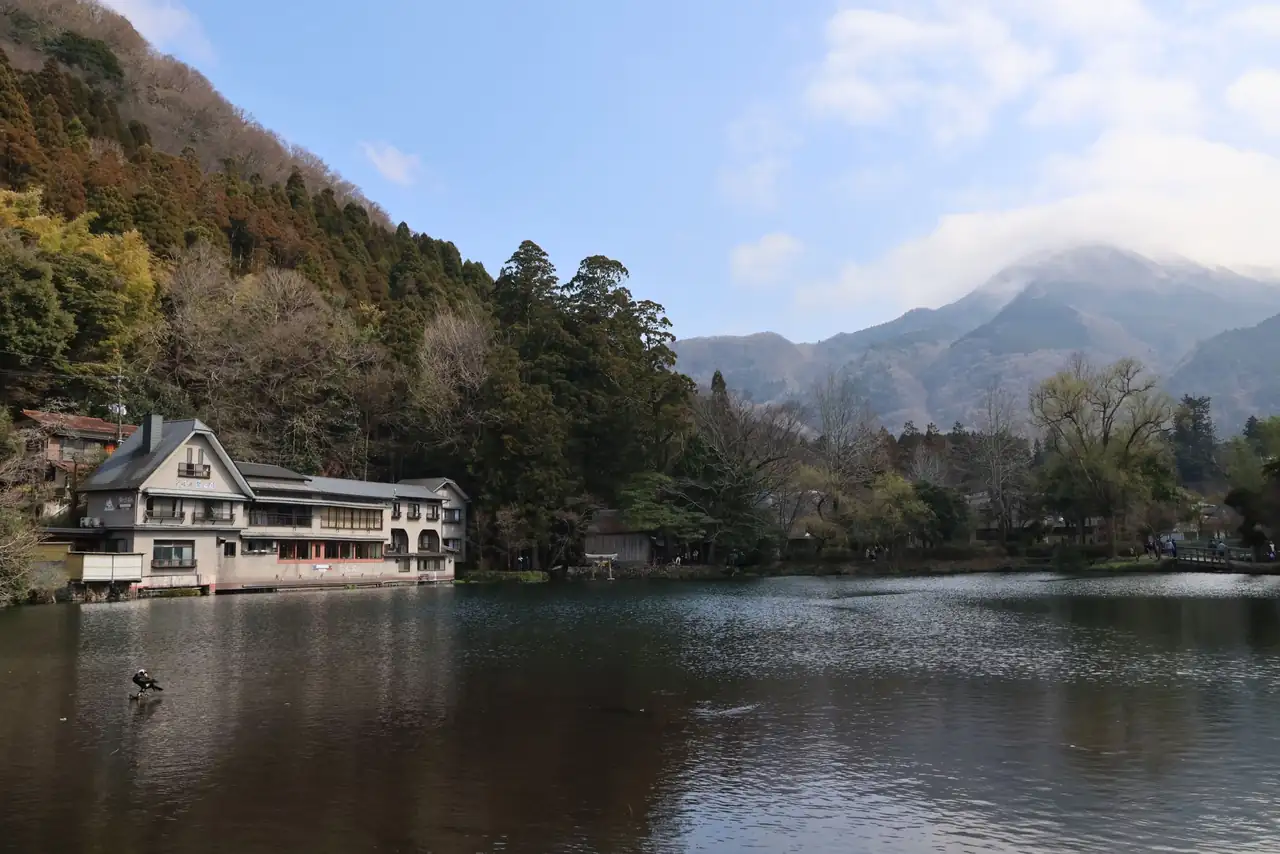
Nestled in a flat, fertile mountain basin thirty minutes west of Beppu beneath the iconic, double-peaked volcanic pyramid of Mount Yufu (Yufudake), the town of Yufuin provides an artistic, tranquil counterpoint to Beppu’s bustling coastal corridors. Strict local zoning regulations banned high-rise hotel development in the 1970s, ensuring the town preserved its rural agrarian streetscape.
Wander down Yunotsubo Kaido, a pedestrian avenue lined with wooden craft boutiques, art galleries, and modern cafes, terminating at Lake Kinrin (Kinrinko). Because both cold mountain runoff and natural boiling hot spring waters bubble upward simultaneously from the lakebed, a mystical blanket of morning steam rises from the water surface on cool autumn and winter mornings, enveloping the lake's floating wooden torii gate in a quiet, ethereal fog.
4. Cross the Sky at the Kokonoe "Yume" Grand Suspension Bridge
Suspended high above the Narukogawa River gorge at an elevation of 777 meters in the Kuju Highlands, the Kokonoe "Yume" Ōtsurihashi is one of the highest pedestrian suspension footbridges in Japan. Spanning 390 meters in length and hanging 173 meters above the canyon floor, crossing the open metal grating provides sweeping views of two thundering cascades: the Shindō-no-taki waterfalls, framed against the ancient virgin beech forests of the Narukogawa Gorge and the volcanic ridges of the Kuju Mountain Range.
5. Uncover Buddhist Mysteries in the Kunisaki Peninsula
Jutting outward into the Seto Inland Sea, the circular volcanic Kunisaki Peninsula is a tranquil rural enclave that preserved ancient Rokugō Manzan culture—a distinctive religious movement that emerged twelve centuries ago where monks lived in volcanic caves and practiced mountain asceticism:
- Fuki-ji: Set in deep cedar woods, this temple’s wooden Ōmidō (Main Hall) was constructed in the twelfth century, standing as the oldest surviving wooden structure in Kyushu and a designated National Treasure housing an eleventh-century wooden statue of Amida Buddha.
- Kumano Magaibutsu: Approached via a steep, uneven stone staircase said by folklore to have been built by an ogre in a single night, two colossal Buddhist figures are carved directly into sheer vertical volcanic cliff rock: an eight-meter-tall Dainichi Nyorai and a ten-meter-tall Fudō Myō-ō, dating back to the late Heian and Kamakura periods.
6. Pay Homage at the Grand Sanctuaries of Usa Jingū
Located at the base of the Kunisaki Peninsula, Usa Jingū was founded in 725 AD as the supreme head shrine among more than 44,000 Hachiman shrines scattered across the Japanese archipelago. Dedicated to Hachiman—the deified spirit of Emperor Ōjin, venerated as the tutelary god of warriors and archery—Usa Jingū holds a paramount role in national history; it was here that imperial messengers arrived to consult the oracle before military campaigns and imperial successions.
The magnificent upper shrine sanctuary (a National Treasure) is constructed in the pure Hachiman-zukuri architectural style, characterized by two parallel timber buildings with interlocking eaves joined together under a single copper-tiled roof. Shrine Ritual Note: While standard Shinto prayer etiquette across Japan dictates two bows, two handclaps, and one final bow (ni-rei, ni-hai, ichi-rei), worshippers at Usa Jingū strictly follow the archaic ritual of four handclaps (ni-rei, yon-hai, ichi-rei), a practice shared only with Izumo Taisha in Shimane.
7. Inspect the Master Carvings of the Usuki Stone Buddhas
Located in the quiet agricultural hills outside the coastal samurai town of Usuki, the Usuki Stone Buddhas (Usuki Magaibutsu) comprise more than sixty magnificent Buddhist images carved directly into soft volcanic tuff cliff faces between the twelfth and fourteenth centuries. Grouped across four forested rocky recesses, the figures are recognized as National Treasures—the only stone carvings in Japan to hold that distinction. The masterpiece of the complex is the seated Dainichi Nyorai, celebrated for its serene facial expression, crisp hair whorls, and fine drapery lines that have survived eight centuries of moss and weather.
Oita Food Culture: Citrus Kabosu, Bungo Beef & Steam Cuisine
Blessed with cold mountain runoff, volcanic geothermal vents, and the deep, nutrient-dense ocean waters of the Bungo Channel, Oita cuisine balances comfort street food with refined culinary craft:
- Jigoku Mushi (Hell-Steamed Cuisine): The definitive culinary experience of Beppu. Dating back to the Edo period, local kitchens harness 100% natural, high-pressure volcanic steam channeled directly from boiling geothermal vents into brick-and-stone cooking wells (Jigoku Mushi Kama). Visitors place bamboo baskets loaded with seasonal vegetables, fresh eggs, sweet potatoes, chicken thighs, and blue crabs into the steam wells. The mineral-rich volcanic steam cooks the ingredients rapidly while locking in natural moisture and infusing the food with subtle, savory minerality. Try this hands-on at the Jigokumushi Kōbō in Kannawa.
- Toriten (Oita Chicken Tempura): Oita’s signature soul food, invented in a Beppu restaurant in the 1920s. Tender strips of chicken thigh or breast are marinated in soy sauce, garlic, and sake, dipped in a light wheat-and-egg batter, and flash-fried until delicate and crispy. Unlike standard karaage (which is coated in potato starch), toriten has a lighter, tempura-style crust, eaten dipped in acidic citrus ponzu mixed with fiery yellow Japanese mustard (karashi).
- Kabosu Citrus: Oita produces over ninety percent of all the Kabosu grown in Japan. This round, dark-green citrus fruit resembles a lime but is characterized by a tart, aromatic acidity with subtle sweetness. Locals squeeze fresh kabosu juice over everything: fresh sashimi, grilled sweetfish, bowls of udon, hot miso soups, and cold mugs of shōchū.
- Seki Aji and Seki Saba (Prized Channel Mackerel): Caught in the treacherous, churning tidal currents of the Hōyo Strait where the Seto Inland Sea meets the Pacific Ocean, Seki horse mackerel (Aji) and chub mackerel (Saba) are legendary nationwide. Caught exclusively via traditional single-hook pole-and-line fishing (ippon-zuri) to prevent bruising, the fish swim against violent currents, developing firm, muscular meat with rich fat marbling. While mackerel is typically salt-cured or pickled elsewhere in Japan to prevent spoiling, Seki Saba is so fresh it is eaten pure as glistening, translucent raw sashimi.
- Bungo Wagyu Beef: Oita’s premier black cattle have been bred across the lush volcanic grasslands of the Kuju highlands since 1921. Bungo Beef is famed for its high concentration of oleic acid, which gives the finely marbled fat a low melting point, producing a sweet, buttery finish when seared over charcoal grills or served as steak in Yufuin’s hot spring ryokans.
- Ryūkyū: A beloved coastal fisherman’s dish. Fresh cuts of raw yellowtail, sea bream, or mackerel are tossed in a rich, savory marinade made from soy sauce, mirin, sake, toasted sesame seeds, and chopped scallions. Eaten over hot steamed rice, or finished at the end of a meal as Ryūkyū-chazuke by pouring hot green tea or dashi broth over the fish.
Transportation: Scenic Mountain Lines & Coastal Expresses
Oita is linked to northern and southern Kyushu via scenic railway routes and an international coastal airport:
- Fukuoka (Hakata) to Beppu & Oita City:
- JR Sonic Limited Express: The fastest connection. Departs JR Hakata Station twice hourly, racing along the northern coastline via Kokura directly to JR Beppu Station in roughly 2 hours (and Oita Station in 2 hours 10 minutes). (Fully covered by the nationwide JR Rail Pass and JR Kyushu Rail Pass).
- Yufuin no Mori: A classic forest-green luxury resort train departing Hakata Station, winding through mountain gorges directly to Yufuin Station in roughly 2 hours and 15 minutes, featuring vintage wood interiors, panoramic salon cars, and onboard craft bento dining.
- Oita Airport (OIT) Transit:
- Located on the coastal tip of the Kunisaki Peninsula. Airliner Express Buses connect the terminal directly to JR Beppu Station (approx. 50 minutes) and JR Oita Station (approx. 60 minutes).
- Hovercraft Ferry: High-speed amphibious hovercraft service connects Oita Airport directly across Beppu Bay to Oita City’s western harbor in roughly 30 minutes.
- Local Transit & Bus Loops:
- Kamenoi Bus Network: Operates frequent city buses connecting Beppu Station to Kannawa, Myoban, and all seven Jigoku hell sites. Purchasing a 1-Day Kamenoi Bus Pass (Mybeppu Free) provides unlimited hops across the thermal basin.
- Digital IC Transit Cards: JR lines (Sonic) and municipal Kamenoi buses accept digital Suica, Pasmo, and ICOCA cards loaded on smartphones.
Where to Stay in Oita: Strategic Base Camps
| Base Hub | Vibe & Atmosphere | Transit Connections | Accommodation Strategy |
|---|---|---|---|
| Beppu City Core (Station & Coast) | Lively seaside onsen resort, retro Showa nightlife, vintage public bathhouses, quick transport hubs. | JR Sonic Express stop; Kamenoi bus terminal; ferry links to Shikoku. | High density of modern Japanese business hotels (multiple central APAs), oceanfront hot spring resort towers, historic public ryokans. |
| Kannawa & Myoban (Upper Beppu) | Atmospheric steam vents, historic stone alleys, sulfur hot springs, authentic steam cooking. | Direct Kamenoi buses from Beppu Station (approx. 15–20 mins). | Traditional hot spring ryokans with private mineral baths, self-catering steam-cook inns (tōji-ya). |
| Yufuin Mountain Basin | Quiet alpine valley, artistic boutiques, misty lakeside trails, Mount Yufu vistas. | JR Kyudai Main Line (Yufuin Station); highway buses to Hakata and Kumamoto. | Exclusive, design-forward luxury hot spring ryokans with detached garden villas, open-air cedar rotenburo, and Bungo beef dining. |
| Oita City Center | Bustling commercial hub, modern architecture, excellent shopping arcades and museums. | Main rail junction for northern and southern Kyushu; airport bus connection. | Clean, cost-effective station-front business hotels, corporate railway towers; practical base for regional business and car rentals. |
Regional Day Trips Across Oita Prefecture
1. Mount Takasaki Wild Monkey Park (Takasakiyama)
Rising along the coastal cliffs between Beppu and Oita City, Takasakiyama Natural Zoological Garden is home to one of the largest concentrations of wild Japanese macaques in the world. Over one thousand wild snow monkeys—divided into two distinct, competing social troops—descend daily from the steep mountain forests to an open-air clearing for scheduled grain and sweet potato feedings. Unlike standard zoos, there are no cages or fences; monkeys roam freely around visitors’ feet and play across the temple steps while park rangers explain social hierarchies and troop leadership dynamics.
2. Kitsuki: The Sandwich Samurai Town
Located on the southern slopes of the Kunisaki Peninsula, Kitsuki is celebrated for its unique "sandwich castle town" topography: two elevated residential plateaus populated by high-ranking samurai estates (Kita-dai and Minami-dai) look down across a central lowland valley populated by merchant shops and taverns. Visitors walk up steep, cobbled stone slopes like Suya-no-saka and Shioya-no-saka, lined with dark timber walls and earthen gates, touring preserved samurai residences like the Ohashi House and Isoya House.
3. Yabakei Gorge: The Tunnel of Zenkai
Carved by the Yamakuni River in northwestern Oita near Nakatsu, Yabakei Gorge is a scenic canyon of rugged volcanic rock formations, stone bridges, and dense forests that blaze in brilliant crimson foliage each autumn. The defining historical landmark is the Aonodōmon (Blue Tunnel)—a 144-meter road tunnel hand-chiseled directly through sheer rock cliffs by a single Buddhist monk named Zenkai, who worked for thirty years with only a hammer and chisel (between 1734 and 1764) to provide safe passage for pilgrims traveling along the treacherous cliffside.
Best Seasons to Visit Oita
- Autumn (October to Late November): The premier season for weather and visual splendor. Temperatures average a comfortable 15°C to 20°C (59°F–68°F). The beech and maple forests of Yabakei Gorge, the Kuju Highlands, and Mount Yufu explode in deep shades of gold and scarlet. Clear, cool autumn mornings create the iconic morning steam fog across Lake Kinrin in Yufuin.
- Spring (Late March to Mid-April): A magnificent season of cherry blossoms. Somei-yoshino trees bloom along the historic moats of Oka Castle ruins in Taketa (ranked among Japan's top 100 sakura spots) and across the grounds of Beppu Park. Pleasant sightseeing weather makes walking the stone alleys of Kitsuki and Kunisaki comfortable.
- Winter (December to February): Cool, crisp, and steamy, with daytime temperatures averaging 4°C to 11°C (39°F–52°F). Winter is the definitive season to experience Oita's hot springs: plumes of geothermal steam rise dramatically into the cold winter air across Beppu’s skyline, and soaking in an outdoor hot spring (rotenburo) facing the dusting snow on Mount Yufu is the quintessential Kyushu winter experience.
- Summer (July to August): Lush and tropical. While coastal Beppu and Oita City experience warm summer temperatures reaching 33°C (91°F), the high-altitude plateaus of the Kuju Mountain Range (sitting above 1,000 meters elevation) provide refreshing, breezy alpine retreats. Summer evenings host vibrant fireworks festivals lighting up Beppu Bay.


 福岡
福岡 長崎
長崎 熊本
熊本 鹿児島
鹿児島 宮崎
宮崎 佐賀
佐賀