

On this page
Nagasaki Travel Guide: Port of Nations, Hidden Christians & Sloping Harbor Views
Nestled around a narrow, fjord-like natural deepwater bay on the westernmost edge of Kyushu, Nagasaki Prefecture (長崎県) possesses the most internationally shaped heritage of any region in Japan. Surrounded on three sides by the East China Sea, the prefecture encompasses roughly 970 islands—the highest island count of any Japanese prefecture. For more than two centuries during the Edo period (1603–1867), when the Tokugawa shogunate enforced national maritime isolation (sakoku) under penalty of death, the artificial fan-shaped island of Dejima in Nagasaki Harbor served as the single authorized gateway connecting Japan to the Western world through the Dutch East India Company (VOC), alongside Chinese trade warehouses across the bay.
This prolonged foreign contact fostered a distinctive cosmopolitan identity that sets Nagasaki apart from the rest of the archipelago. It was the entry point for Western medicine, printing presses, chocolate, firearms, and bread, as well as the crucible for the survival of the Kakure Kirishitan (Hidden Christians), who practiced their faith in secret mountain hamlets and remote islands for over 250 years despite severe shogunal persecution. On August 9, 1945, Nagasaki became the second and final city in history to suffer an atomic bombing; yet like Hiroshima, it rebuilt itself into an energetic, forward-looking city of peace. Characterized by steep terraced hillsides, vintage electric streetcars, European stone churches, and sweeping panoramic nightscapes, Nagasaki provides a fascinating window into Japan’s early foreign diplomacy and resilience.
Navigating Nagasaki Prefecture: Core Geographic Sectors
Nagasaki’s geography is fragmented by jagged peninsulas, secluded coves, and outlying island chains, dividing travel into four distinct corridors:
| Sector | Primary Station Hubs | Landscape & Atmosphere | Key Highlights |
|---|---|---|---|
| Nagasaki City Core | JR Nagasaki Station / Shinchi Chinatown | Terraced hillside amphitheater, deepwater commercial harbor, vintage electric streetcars, foreign treaty-port estates. | Peace Memorial Park & Atomic Bomb Museum, Glover Garden, Dejima, Oura Church, Mount Inasa, Shinchi Chinatown. |
| Sasebo & Omura Bay (North) | JR Sasebo / Huis Ten Bosch | Naval shipyards, US naval fleet presence, scenic ninety-nine coastal pine islands, massive Dutch heritage park. | Kujukushima Islands, Huis Ten Bosch resort, Sasebo burger docks, Miiraku coastal lookouts. |
| Shimabara Peninsula (East) | Shimabara / Unzen Onsen | Active volcanic calderas, boiling sulfuric solfataras, spring-fed samurai canals, feudal rebellion battlefields. | Unzen Jigoku (Hells), Mount Fugen (Heisei Shinzan), Shimabara Castle & Samurai Residences, carp swimming street. |
| Gotō Islands & Outlying Seas | Fukue Port / Arikawa (Ferry access) | Remote volcanic archipelagos, hidden Christian brick basilicas, turquoise coral bays, dramatic sea cliffs. | UNESCO Hidden Christian sites (Dozaki Church, Egami Church), Takahama Beach, Osezaki Lighthouse. |
Top Things to Do Across Nagasaki
1. Reflect on Resilience at the Peace Park & Atomic Bomb Museum
Situated in the northern Urakami district of Nagasaki City, the Peace Memorial Park (Heiwa Kōen) marks the geographic reality of August 9, 1945, when the plutonium bomb nicknamed "Fat Man" detonated five hundred meters above the valley floor. The park centers on the monumental ten-meter-tall bronze Peace Memorial Statue sculpted by Seibo Kitamura: its right hand points toward heaven to warn of the threat of nuclear weapons, its extended left hand gestures horizontally toward eternal peace, and its gently closed eyes offer a silent prayer for the victims.
A short walk down the hill leads to the Hypocenter Cenotaph, where a black granite monolith marks the exact ground zero point beneath the aerial explosion, surrounded by preserved strata of scorched earth and melted roof tiles. Continue into the Nagasaki Atomic Bomb Museum, which provides a comprehensive, harrowing documentation of the bombing, the medical aftermath, and ongoing global nuclear non-proliferation efforts. Nearby stand the reconstructed twin brick spires of Urakami Cathedral—once the largest Catholic church in East Asia, destroyed in the blast and rebuilt by parishioners.
2. Step Back into the Isolation Era at Dejima
Constructed in 1636, Dejima was a fan-shaped artificial island covering just 1.5 hectares, excavated to isolate Portuguese traders and later designated as the exclusive trading post of the Dutch East India Company from 1641 to 1859. For over two centuries, this tiny walled compound was the only place in Japan where Westerners could reside, strictly monitored by shogunal samurai guards.
While nineteenth-century land reclamation gradually absorbed the island into the modern city grid, Nagasaki has completed a painstaking historical restoration of Dejima. Today, visitors cross a timber footbridge to walk down a recreation of the main cobblestone avenue, exploring sixteen restored wooden merchant warehouses, the Dutch Chief Factor's residence (Capitan's Room), the clerk quarters, and traditional gardens, viewing historical navigational maps, glassware, and spices that filtered into Japan during isolation.
3. Walk the Slopes of Glover Garden & Oura Church
Perched high on the Minami-Yamate hillsides overlooking Nagasaki Harbor, Glover Garden is an open-air architectural museum preserving Western-style merchant residences built following the reopening of Japan in 1859. The centerpiece is the Former Glover House, built in 1863 for Scottish merchant Thomas Blake Glover. Recognized as the oldest surviving Western-style wooden building in Japan, the bungalow incorporates Japanese tile roofing and sliding doors alongside British colonial open-veranda architecture. Glover played an instrumental role in Japan's Meiji-era industrial modernization, helping establish the Kirin Brewery and modern coal mining operations at Hashima Island (Gunkanjima).
At the foot of the hill leading to Glover Garden stands Oura Church (Oura Tenshudō). Constructed in 1864 by French Catholic missionaries to honor the Twenty-Six Martyrs of Japan crucified in Nagasaki in 1597, it is the oldest standing Christian church in Japan and a designated National Treasure. It was here in March 1865 that a group of local farming families from Urakami quietly approached the French priest Bernard Petitjean, whispering: "Our hearts are the same as yours"—marking the dramatic "Discovery of the Hidden Christians," who had kept their Catholic prayers, baptisms, and faith intact entirely in secret without priests for seven generations.
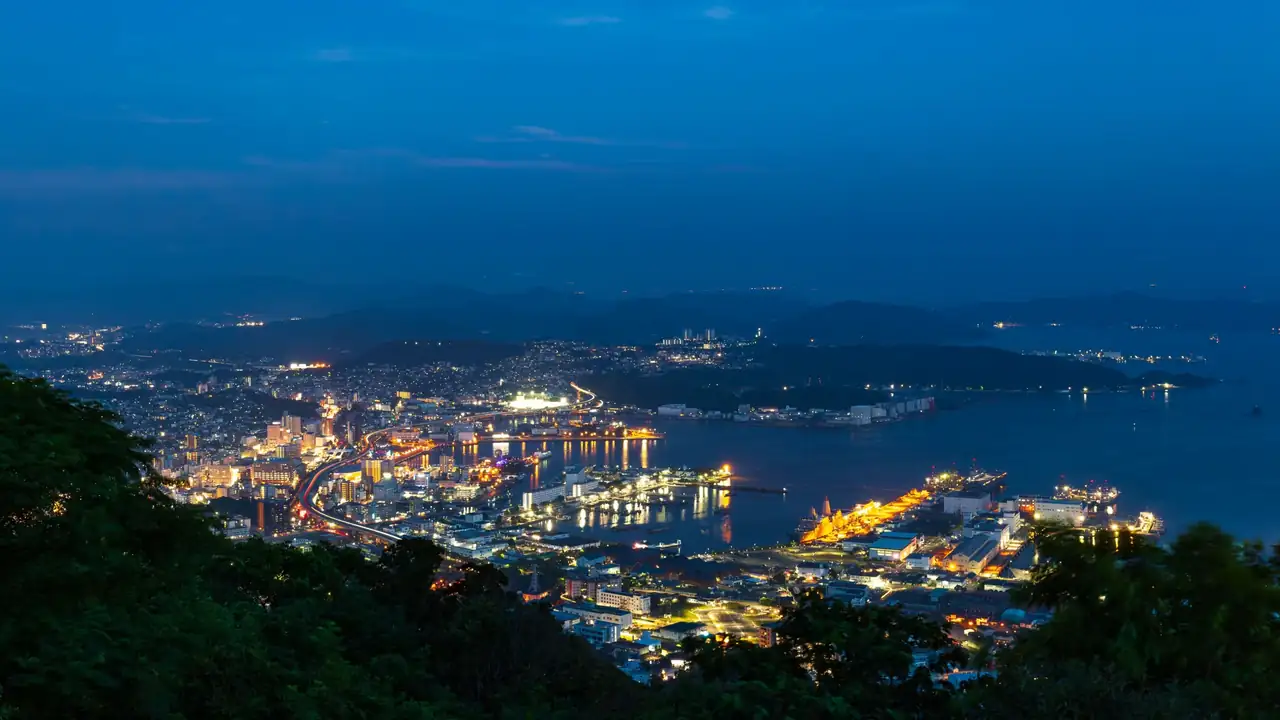
4. Ascend Mount Inasa for the "Ten-Million-Dollar" Night Vista
Rising 333 meters directly across the western side of the harbor, Mount Inasa (Inasayama) offers one of the most celebrated cityscape viewpoints in the world. Ranked alongside Monaco and Shanghai as one of the "Three Great Night Views of the World" (and alongside Kobe and Sapporo within Japan), Nagasaki's unique bowl-shaped topography causes tens of thousands of residential and street lights to cling to the steep mountain slopes rising immediately out of the dark water.
Board the Nagasaki Ropeway from Fuchi Shrine—gliding upward inside sleek glass-walled cabins designed by Ferrari designer Ken Okuyama—or take the scenic hillside slope car to the glass-walled circular summit observatory. Arrive just before twilight to watch the sun set over the East China Sea while the harbor lights illuminate below.
5. Cruise to Hashima Island (Gunkanjima: Battleship Island)
Lying fifteen kilometers southwest of Nagasaki Harbor, Hashima Island—popularly known as Gunkanjima (Battleship Island) due to its stark silhouette resembling the Japanese battleship Tosa—is one of the most haunting industrial ruins on earth. From 1890 until 1974, the island was operated by the Mitsubishi Corporation as a high-grade undersea coal mining facility, with mining shafts extending over one thousand meters beneath the ocean floor.
At its peak in 1959, Hashima housed over 5,200 residents on just 6.3 hectares of land, yielding the highest population density ever recorded in human history (over nine times denser than modern Tokyo). To house miners and their families, Japan's very first reinforced multi-story concrete apartment blocks were erected here. Following the closure of the mines in 1974, the island was abandoned overnight. Today, licensed sightseeing boat tours depart from Nagasaki Harbor, allowing visitors to walk secure boardwalks amid the crumbling, salt-weathered concrete apartment canyons (inscribed as a UNESCO World Heritage industrial site). Note: Boat landings are subject to sea swells and weather conditions.
6. Explore the Volcanic Hellscapes of Unzen Onsen
Perched high in the forested volcanic highlands of the Shimabara Peninsula, Unzen Onsen was designated as Japan's very first National Park in 1934. The thermal heart of the village is Unzen Jigoku (Unzen Hells), an active geothermal field where plumes of white sulfuric steam roar out of fissures in the bleached white rock ground. Wooden footpaths wind through bubbling mud pots, boiling mineral vents, and hot sulfur streams.
Beyond its therapeutic onsen waters, Unzen carries a dark feudal history: between 1627 and 1632, shogunal officials used the boiling sulfur pits of Unzen Jigoku to torture Japanese Christians who refused to renounce their faith (fumi-e). Today, stone memorial crosses overlook the steaming vents. The nearby Nita Pass Ropeway ascends to views of Heisei Shinzan, a dramatic volcanic lava dome that formed during the violent 1990–1995 eruptions of Mount Fugen.
7. Discover the Remote Basilicas of the Gotō Islands
Stretching into the East China Sea seventy kilometers west of the mainland, the Gotō Islands (Five Islands) are an archipelago of dramatic coastal cliffs, pristine sandy beaches, and profound religious heritage. During the height of the Tokugawa anti-Christian edicts, hundreds of Hidden Christian families fled the mainland by fishing boat to settle in the most inhospitable, remote coves of Gotō.
Following the lifting of the religious ban in 1873, these impoverished communities gathered their modest savings to erect striking places of worship with the help of master church architects like Tetsukawa Yosuke. Highlights include the red-brick Gothic Dozaki Church on Fukue Island, the wooden rib-vaulted Egami Church on Naru Island, and Kashiragashima Church, constructed entirely from local sandstone blocks. The archipelago is also celebrated for Takahama Beach, with its turquoise waters and fine white sand.
Nagasaki Terroir: Shippoku Banquets, Champon & Castella Cake
Because Nagasaki served as Japan's sole window to the outside world for centuries, its food culture is an extraordinary fusion of Chinese, Dutch, Portuguese, and regional Kyushu ingredients:
- Nagasaki Champon: The definitive local soul food. Invented in 1899 by Chinese immigrant Chen Ping-shun at the historic restaurant Shikairō outside Oura Church, Champon was created as a cheap, nutritious meal for impoverished Chinese students. Unlike standard ramen, Champon noodles are cooked directly in the boiling soup. A rich, creamy broth made from pork bones and chicken frames is simmered with over a dozen ingredients: cabbage, bean sprouts, sliced pork belly, squid, squid rings, plump coastal shrimp, and pink fish cakes (kamaboko).
- Sara Udon: Champon's crisp companion dish. A mountain of stir-fried seafood, pork, and vegetables bound in a thick, savory cornstarch glaze, poured over a bed of ultra-crispy, deep-fried thin noodles (or soft thick noodles). Diners traditionally splash Worcestershire sauce or rice vinegar over the noodles before eating.
- Shippoku Ryōri (The Port Banquet): Nagasaki’s prestigious banquet tradition, blending Chinese group dining with European table etiquette and Japanese seasonal aesthetics. Diners sit around a circular red-lacquered table (marutaku) with no designated head of the table, symbolizing equality among guests. The meal begins without a formal toast when the host states: "O-hille o kudasai" (Please enjoy the soup), followed by sharing courses of sea bream fin soup (Ohille), braised pork belly (Kakuni), sashimi, and sweet red bean soup.
- Castella Cake (Kasutera): The undisputed signature confectionery of Nagasaki. Introduced by Portuguese merchant mariners in the mid-sixteenth century as Pão de Castela ("bread from Castile"), this moist, fine-crumbed golden sponge cake is baked from simple ingredients: eggs, flour, sugar, and mizuame starch syrup, without artificial oils or leavening agents. The mark of authentic traditional Nagasaki castella—perfected by centuries-old houses like Fukusaya (operating since 1624)—is a dense, crunchy layer of unmelted coarse sugar crystals (zarame) lining the bottom crust.
- Nagasaki Kakuni Manjū: Tender slabs of skin-on pork belly slow-braised for hours in sweet soy sauce, mirin, and sake until the fat turns gelatinous and melts on the tongue. The rich meat is tucked into a warm, fluffy, folded white steamed wheat bun (resembling Chinese bao), served as a street snack in Shinchi Chinatown.
- Toruko Rice (Turkish Rice): A quirky, comforting Western-fusion dish invented in Nagasaki cafes in the 1950s. A single large plate is piled with three distinct staples: seasoned pilaf or butter rice, a crispy deep-fried pork cutlet (tonkatsu) smothered in demi-glace sauce, and a generous portion of stir-fried ketchup-spaghetti (Napolitan), garnished with potato salad.
- Goto Udon: Originating on the remote Gotō Islands, this is celebrated as one of Japan’s "Three Great Udon Noodles." Hand-stretched using local camellia oil (tsubaki abura), these noodles are unusually thin, round, and smooth, possessing an elastic, toothsome chew. Traditionally served Jigoku-daki ("boiled in hell")—lifted piping hot straight out of a bubbling iron tabletop pot, dipped in a rich flying fish broth (Ago-dashi) or raw egg with scallions.
Transportation: The Nishi-Kyushu Shinkansen & Vintage Streetcars
Reaching and navigating Nagasaki combines brand-new high-speed rail engineering with Japan's most affordable vintage streetcars:
- The Nishi-Kyūshū Shinkansen (Kamome):
- High-speed bullet train service connects Takeo-Onsen Station to JR Nagasaki Station in just 30 minutes aboard custom six-car Shinkansen trains designed by Eiji Mitooka.
- The "Relay" Transit from Hakata (Fukuoka): To reach Nagasaki from Fukuoka, board the Relay Kamome Limited Express from JR Hakata Station to Takeo-Onsen (approx. 60 minutes), where you make a seamless, cross-platform transfer (walking across the same track platform in three minutes) to the Nishi-Kyūshū Shinkansen onward to Nagasaki. Total journey time: roughly 1 hour 25 minutes. (Fully covered by the nationwide JR Rail Pass and JR Kyushu Rail Pass).
- Nagasaki Electric Tramway (Streetcars): The easiest, most charming way to navigate Nagasaki City. Four tram lines (Blue, Red, Yellow, Green) crisscross the urban valley, stopping directly outside Peace Park, Dejima, Shinchi Chinatown, and Oura Church.
- Flat Fare: Fares are a flat ¥140 per ride regardless of distance, or ¥600 for an unlimited 1-Day Tram Pass.
- Payment: Streetcars fully accept digital Suica, Pasmo, and ICOCA cards loaded on smartphones; simply tap your phone at the exit reader near the driver.
- Reaching the Gotō Islands:
- High-Speed Jetfoil: Departs Nagasaki Harbor Pier directly to Fukue Port in roughly 1 hour and 25 minutes (Kyushu Shosen).
- Car Ferries: Slower, scenic passenger and vehicle ferries take roughly 3 hours and 10 minutes.
Where to Stay in Nagasaki: Strategic Base Camps
| Base Hub | Vibe & Atmosphere | Transit Connections | Accommodation Strategy |
|---|---|---|---|
| JR Nagasaki Station Core | Modern terminal hub, multi-level retail shopping, rapid Shinkansen and highway bus access. | Nishi-Kyūshū Shinkansen; JR regional lines; central streetcar stops. | High density of modern, efficient Japanese business hotels (multiple central APAs), railway towers, corporate lodgings. |
| Shinchi Chinatown & Hamamachi | Lively dining district, pedestrian covered shopping arcades, evening street food, nightlife. | Central streetcar interchange (Tsukimachi / Shinchi Chinatown). | Stylish lifestyle boutique hotels, clean chain business hotels, budget urban apart-hotels. |
| Mount Inasa Slopes | Elevated tranquility, panoramic night views sweeping across the illuminated harbor bowl. | Hillside road access; hotel shuttles from Nagasaki Station. | Upscale scenic view hotels, luxury ryokans with glass-walled dining rooms and open-air hot spring baths. |
| Unzen Onsen (Shimabara) | Highland volcanic serenity, mountain mist, soothing mineral hot springs. | Direct highway bus from Nagasaki Station (approx. 100 mins); ferry from Kumamoto. | Historic hot spring ryokans with private sulfuric outdoor baths (rotenburo) and multi-course Shimabara beef kaiseki dining. |
Regional Day Trips Across Nagasaki Prefecture
1. Sasebo & The Kujūkushima Pine Islands
Located ninety minutes north of Nagasaki City on the JR Seaside Liner, Sasebo is a historic naval port city framed by the Kujūkushima ("Ninety-Nine Islands")—a breathtaking coastal archipelago of 208 densely wooded, pine-covered islands scattering into the azure waters of the Saikai National Park. Take an island cruise aboard passenger catamarans, gaze out from the Tenkaihō Observatory, and bite into an authentic Sasebo Burger—massive, hand-crafted hamburgers prepared with fried eggs, thick bacon, and sweet mayonnaise, introduced by US Navy sailors stationed here in the 1950s.
2. Huis Ten Bosch (Dutch Cultural Resort)
Occupying 152 hectares along the shores of Omura Bay near Sasebo, Huis Ten Bosch is Japan’s largest single-theme amusement park resort, faithfully reconstructing a 17th-century Dutch city. The park features full-scale brick replicas of royal palaces (including the Palace Huis Ten Bosch in The Hague), working windmills, brick canals navigated by cruise boats, and seasonal gardens that bloom with millions of Dutch tulips in spring. As evening falls, the entire park illuminates in one of Asia’s largest seasonal light displays.
3. Shimabara Castle & The City of Swimming Carp
Situated on the eastern coast of the Shimabara Peninsula, Shimabara is a historic feudal castle town anchored by the stark white, five-tier keep of Shimabara Castle. The castle museum details the bloody 1637–1638 Shimabara Rebellion, when heavily taxed peasants and masterless Christian samurai (ronin) rose up against the shogunate in a siege at nearby Hara Castle. A short walk away lies the preserved Teppō-machi Samurai District, where clear, spring-fed stone water channels run down the center of flagstone streets, while in the downtown Koi-no-Oyogu-Machi district, thousands of colorful Nishikigoi carp swim through the fresh gutters running past residential doorways.
Best Seasons to Visit Nagasaki
- Autumn (October to Late November): The premier season for weather and cultural spectacle. Temperatures are mild and comfortable, averaging 16°C to 21°C (61°F–70°F) with low rainfall. October brings the headline cultural event of the year: the Nagasaki Kunchi Festival (October 7–9). Dating back to 1634 at Suwa Shrine, this high-energy festival features neighborhood teams performing dramatic, acrobatic Ja-odori (Chinese dragon dances) and hauling wooden ship floats (Nanbansen) through roaring crowds chanting "Mottekoi!" (Bring it back!).
- Winter (January to February): Cool, crisp, and coastal, with daytime temperatures averaging 5°C to 11°C (41°F–52°F). Winter hosts the breathtaking Nagasaki Lantern Festival, coinciding with the Lunar New Year (January/February). For fifteen days, over fifteen thousand glowing red, yellow, and pink Chinese paper lanterns illuminate Shinchi Chinatown, Meganebashi (Spectacles Bridge), and the Nakashima River, accompanied by lion dances and imperial processions.
- Spring (Late March to Mid-April): A magnificent season of cherry blossoms. Somei-yoshino trees frame the stone bridges of the Nakashima River, the parks of Glover Garden, and the ramparts of Shimabara Castle. Warm, temperate sightseeing weather averaging 14°C to 19°C (57°F–66°F).
- August 9 (Nagasaki Peace Memorial Ceremony): A profound, moving time to be in the city. At 11:02 AM, the exact moment the bomb fell, bells toll across the city as sirens sound and citizens pause for a minute of silent prayer. In the evening, thousands of paper lanterns carrying personal prayers are floated down the Urakami River in remembrance of the victims.
- Summer (July to August): Warm, humid, and tropical. While temperatures reach 32°C (90°F), summer is the prime window for exploring the remote beaches and sea caves of the Gotō Islands and embarking on open-sea cruises to Hashima (Battleship Island).


 福岡
 熊本
 大分
 鹿児島
 宮崎
 佐賀