

On this page
Saga Travel Guide: The Birthplace of Japanese Porcelain, Yayoi Kingdoms & Squid Ports
Nestled in northwestern Kyushu between the commercial metropolis of Fukuoka and the historic port peninsula of Nagasaki, Saga Prefecture (佐賀県) is one of Japan's most historically innovative yet quietly underrated domains. Historically designated as Hizen Province (which it once shared with Nagasaki), Saga is bordered by two contrasting marine bodies: the tranquil, nutrient-dense tidal mudflats of the Ariake Sea to the south and the dramatic, wave-sculpted granite coast of the Genkai Sea to the north. Connecting these two seas lies the fertile Saga Plain, an expansive agrarian basin crossed by centuries-old irrigation creeks.
During the Edo period, the ruling Nabeshima clan of the Saga Domain steered a policy of scientific curiosity, embracing Western artillery, medicine, and steamship engineering that positioned Saga as an intellectual engine of Japan's nineteenth-century modernization. Long before that, Saga was the crucible of East Asian cultural exchange: it is the birthplace of Japanese porcelain, ignited in 1616 when Korean potter Yi Sam-pyeong discovered rich porcelain stone at Mount Izumi in Arita, giving rise to the global export phenomenon of Imari ware. Further back in antiquity, the moated settlement of Yoshinogari stands as Japan’s largest and most significant Yayoi-period archaeological site, evoking the mysterious bronze-age kingdom of Yamatai. From the dramatic stilted hillside terraces of Yūtoku Inari Shrine and the translucent live squid of Yobuko to the therapeutic alkaline waters of Ureshino Onsen, Saga provides an authentic, high-craft escape right in the heart of northern Kyushu.
Navigating Saga Prefecture: Core Geographic Sectors
Saga’s compact geography transitions from northern sea cliffs down through pottery mountains to the southern tidal flats, dividing into four distinct travel corridors:
| Sector | Primary Station Hubs | Landscape & Atmosphere | Key Highlights |
|---|---|---|---|
| Saga Plain & Eastern Archaeology | JR Saga / Yoshinogari-Kōen / Tosu | Prefectural castle capital, vast agricultural plains, high-density rail junctions, Yayoi-period moated kingdoms. | Yoshinogari Historical Park, Saga Castle History Museum, Saga International Balloon Fiesta grounds. |
| Arita & Imari Ceramic Belt (West) | JR Arita / JR Imari / Kami-Arita | Wooded mountain valleys, red-brick climbing kilns, porcelain shrines, historic porcelain merchant quarters. | Tozan Shrine (porcelain torii), Mount Izumi quarry, Kyushu Ceramic Museum, Ōkawachiyama ("Village of Secret Kilns"). |
| Karatsu & The Genkai Coast (North) | JR Karatsu / Nishi-Karatsu / Yobuko | Coastal samurai castle keeps, pine-fringed beaches, morning fishing markets, live squid harbors, festival float halls. | Karatsu Castle ("Dancing Crane"), Nijino-matsubara pine grove, Yobuko Morning Market, Karatsu Kunchi float hall. |
| Ureshino, Kashima & Ariake (South) | Ureshino-Onsen (Shinkansen) / JR Hizen-Kashima | Thermal hot spring tea valleys, grand hillside cliff shrines, sake brewery streets, dramatic tidal mudflats. | Yūtoku Inari Shrine, Ureshino Onsen (tea baths & hot spring tofu), Kashima Sakagura Dori, Takeo Onsen tower gate. |
Top Things to Do Across Saga
1. Step into the Bronze Age at Yoshinogari Historical Park
Spanning over one hundred hectares across the rolling plains of Kanzaki and Yoshinogari, Yoshinogari Historical Park is the largest and most extensively excavated Yayoi-period (approx. 300 BC – 300 AD) archaeological settlement in Japan. The discovery of this massive, multi-ditched moat settlement in 1989 revolutionized historical understanding of early Japanese state formation, leading many historians to link it directly to the ancient kingdom of Yamatai and the shaman queen Himiko.
The park is a living open-air reconstruction: visitors walk through outer and inner defensive moats studded with wooden palisades, watchtowers, and pit dwellings. Highlights include the Northern Enclosure (Kita-Naikaku)—the sacred administrative compound where Yayoi chieftains and priestesses held divinations—centered around a monumental, three-story thatched wooden ritual hall. Nearby sits the Northern Burial Mound, where dozens of authentic two-thousand-year-old unglazed ceramic burial urns (Kamekan) containing human remains and bronze swords are preserved in situ inside an atmospheric subterranean hall.
---
2. Trace 400 Years of Porcelain Heritage at Arita & Tozan Shrine
Tucked into a narrow mountain valley in western Saga, Arita is the undisputed birthplace of Japanese porcelain. When Korean ceramic master Yi Sam-pyeong discovered high-grade kaolin clay at Mount Izumi in 1616, Arita’s artisans mastered high-temperature wood firing and overglaze enamel painting (pioneered by Sakaida Kakiemon), exporting millions of blue-and-white and polychrome porcelain pieces to European royal courts through the nearby port of Imari.
The spiritual centerpiece of the pottery town is Tozan Shrine (Sueyama Jinja), dedicated to the guardian deity of ceramics and Yi Sam-pyeong. In place of standard stone or wood, the shrine is famous for its striking Porcelain Torii Gate, erected in 1888. Standing over three meters tall, the gate is crafted entirely from white Arita porcelain painted with delicate blue arabesque patterns. The shrine precinct also features porcelain guardian lion-dogs (komainu), porcelain lanterns, and large porcelain balustrades, all crafted by local master kilns. Stroll down the Tonbai-wall Alleys, lined with rustic earthen walls constructed from discarded kiln bricks (tonbai) and fragments of old ceramic crucibles cemented with red clay.
---
3. Climb the Stilted Hillside Terraces of Yūtoku Inari Shrine
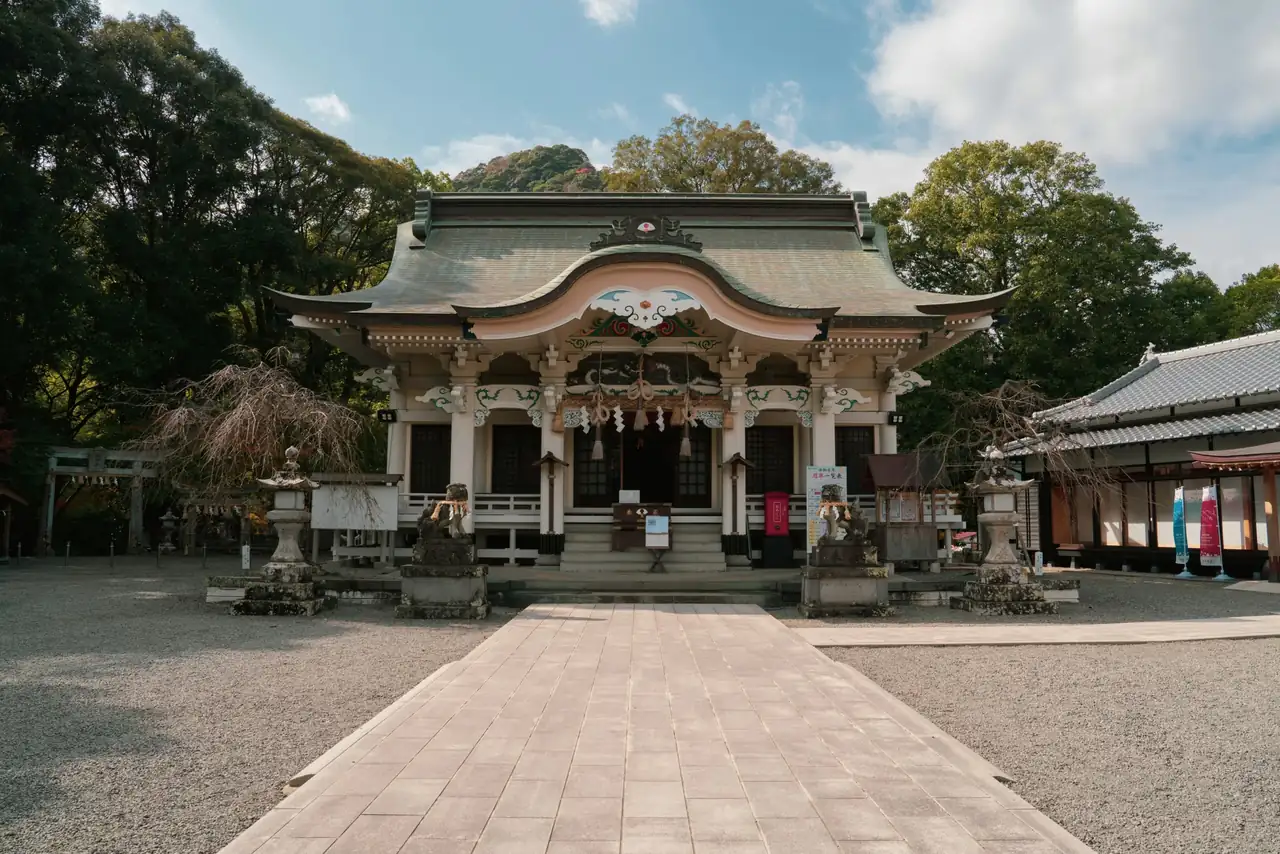
Nestled against a steep, wooded mountain ridge in Kashima, Yūtoku Inari Shrine (Yūtoku Inari Jinja) was established in 1679 by Princess Manko, wife of the third Nabeshima lord. Enshrining the deities of agriculture, prosperous commerce, and family harmony, it is ranked alongside Fushimi Inari in Kyoto and Toyokawa Inari in Aichi as one of the Three Great Inari Shrines of Japan.
The architectural showstopper is the monumental Main Prayer Hall (Gohonzen), painted in brilliant scarlet, emerald, and gold lacquer. Like Kyoto’s Kiyomizu-dera, the entire hall is elevated eighteen meters into the air, supported by an intricate, multi-tiered structural framework of red timber stilts (Kake-zukuri) anchored directly into the rock face. Visitors climb timber stairways to the main terrace for panoramic views over the shrine gardens and valley below, before following a winding mountain trail of hundreds of bright red torii gates that zigzag up the hillside through cedar woods to the summit sanctuary (Okunoin), which looks out across the Ariake Sea.
---
4. Discover the Secluded Potter Enclave of Ōkawachiyama (Imari)
Hidden deep inside a sheer, horseshoe-shaped amphitheater of jagged volcanic granite peaks outside Imari, Ōkawachiyama was developed in 1675 by the Nabeshima clan as an elite, hyper-secret ceramic production enclave. Here, master artisans were gathered under armed guard to produce Nabeshima ware (Nabeshima-yaki)—exquisite, flawless porcelain pieces reserved exclusively as gifts for the Tokugawa Shogun, imperial nobility, and regional daimyo, with guards stationed at the valley gates to prevent the secret formulas and techniques from leaking to rival domains.
Today, this "Village of the Secret Kilns" remains remarkably atmospheric. Roughly thirty active porcelain kilns line the narrow cobblestone lanes, with brick chimneys rising against mist-veiled granite cliffs. The village features porcelain-tiled bridges, ceramic wind chimes that chime melodically in the mountain breeze, and the historic Nabeshima Clan Kiln Park, where visitors can inspect the stepped foundations of original seventeenth-century climbing kilns (noborigama).
5. Gaze Across the Genkai Sea from Karatsu Castle
Rising dramatically from a seaside rocky promontory overlooking Karatsu Bay, Karatsu Castle (Karatsu-jō) was constructed in 1608 by Terasawa Hirotaka using timber salvaged from Toyotomi Hideyoshi’s nearby invasion fortress at Nagoya Castle. The castle earned the poetic nickname Maizuru-jō ("Dancing Crane Castle") because the five-story white keep resembles the head of a crane, with the sweeping sandbars and pine forests of Nijino-matsubara and Nishi-no-hama extending on either side like its outspread wings.
Visitors ascend stone ramps or a modern cliffside elevator to the high bailey, which features a monumental grove of purple wisteria vines (Noda-fuji) over a century old, blooming across a sprawling overhead trellis every late April. The top floor of the keep provides sweeping vistas over the Genkai Sea and the Nijino-matsubara (Rainbow Pine Grove)—a designated Special Place of Scenic Beauty comprising over one million black pine trees planted along a five-kilometer coastal curve to shield farming plains from sea winds.
6. Step Beneath the Dragon Palace Gate at Takeo Onsen
Boasting a recorded history spanning over 1,300 years and documented in eighth-century chronicles, Takeo Onsen is a historic thermal resort renowned for its silky, alkaline simple spring waters, frequented historically by legendary figures such as samurai warlord Miyamoto Musashi and German physician Philipp Franz von Siebold.
The symbolic landmark of the town is the Takeo Onsen Rōmon (Tower Gate), an eye-catching two-story wooden gate painted in vermilion and white lacquer, constructed in 1615 without using a single metal nail. Designed by celebrated Meiji-era architect Kingo Tatsuno (a native of Karatsu who also designed the iconic red-brick Tokyo Station), the gate is modeled after the mythical Ryūgū-jō (the Sea God’s underwater Dragon Palace). Inside the gate, the historical Shinnokan bathhouse ceiling preserves four carved wooden zodiac signs (Rat, Horse, Rabbit, Rooster), which famously complete the missing eight zodiac signs found beneath the dome ceiling of Tokyo Station.
7. Watch Hot Air Balloons Paint the Sky at the Saga Balloon Fiesta
Held annually in late October or early November along the wide, flat riverbanks of the Kase River outside Saga City, the Saga International Balloon Fiesta is the largest hot air balloon competition in Asia. Because the Saga Plain is framed by mountains that generate predictable, gentle morning air currents, it provides some of the world's finest aerodynamic conditions for competitive ballooning.
Over one hundred colorful hot air balloons from across the globe take flight simultaneously at dawn, filling the crisp autumn sky with an extraordinary, glowing tapestry of color reflected across the calm river water. In the evening, the festival stages La Montgolfier Nocturne (Night Glow), where moored balloons illuminate their burners in rhythm to live orchestral music against the dark night sky, concluding with fireworks.
Saga Food Culture: Translucent Squid, Saga Wagyu & Onsen Tofu
Bordered by nutrient-dense coastal currents, mineral-rich mudflats, and expansive rice plains, Saga boasts an extraordinary and distinctive culinary repertoire:
- Yobuko no Ika (Translucent Live Squid): The port town of Yobuko on the northern Genkai coast is universally recognized as the Squid Capital of Japan. The turbulent, cold offshore waters yield pristine Japanese swordtip squid (Kensaki-ika) and bigfin reef squid.
- Iki-zukuri (Live Preparation): Master chefs net the swimming squid from aerated seawater tanks and prepare it in under a minute with surgical precision. The squid is served so fresh that its flesh is completely transparent and glass-like, with its tentacles still gently moving and chromatophore pigment cells pulsing across its skin. The meat is sweet, crisp, and crunchy.
- The Second Course: After the raw sashimi body is consumed, the kitchen takes the remaining head and tentacles, flash-frying them into light, golden Squid Tempura (Gesoten) or grilling them with coarse sea salt. Pair it with Ika Shūmai (steamed dumplings wrapped in shredded squid ribbons).
---
- Saga Beef (Saga-gyū): One of the most strictly graded wagyu brands in Japan. Derived exclusively from certified Japanese Black cattle fattened on the clean mountain water and rich rice straw of the Saga Plain, only cattle achieving a meat quality score of Grade 4 or 5 with a marbling score (BMS) of 7 or higher can be sold under the official Saga Beef label (lower grades are sold as Saga Cattle). The beef is famous for its intricate, glossy marbling known as Tsuyasashi, featuring a low fat melting point that dissolves into a sweet, velvety richness on the tongue. Savor it seared over high-heat charcoal griddles, as teppanyaki steaks, or simmered in sukiyaki.
- Ureshino Onsen Yudōfu (Hot Spring Tofu): The signature culinary delicacy of Ureshino Onsen. Fresh local silken tofu made from 100% Saga-grown soybeans is simmered in an earthenware pot filled with natural alkaline hot spring mineral water pumped straight from the local springheads. The unique alkaline chemistry of the thermal water naturally breaks down the tofu's coagulants: as it simmers, the edges of the tofu dissolve, transforming the cooking water into a rich, milky-white broth. The tofu becomes meltingly soft and velvety, served with a savory dipping sauce made of sweet soy sauce, sesame seeds, grated ginger, and scallions. When the tofu is finished, cooks often stir cooked rice into the remaining milky soy-mineral broth to make comforting rice porridge (Zōsui).
- Takezaki Crab (Takezaki Gani): Blue swimming crabs (Gazami) caught in the shallow, nutrient-dense tidal mudflats of Tara along the Ariake Sea. Because the Ariake Sea experiences a massive six-meter tidal shift, the seabed is brimming with rich plankton and minerals. The crabs are extraordinarily sweet and packed with meat; male crabs are prized for rich meat in summer and autumn, while female crabs landed in winter are packed with rich orange coral (roe). Typically boiled or steamed whole in ocean water with local sake.
- Saga Nori (Ariake Sea Seaweed): Saga produces more Nori (cultivated edible seaweed) than any other prefecture in Japan, leading national production volume and value for roughly two decades. The wide tidal flats and incoming fresh river waters of the Ariake Sea create optimal salinity and nutrient conditions, yielding nori sheets with a deep, jet-black luster, a meltingly tender mouthfeel, and an intense roasted-ocean aroma.
- Ureshino Green Tea (Ureshinocha): Cultivated in the misty, sun-sheltered mountain valleys of southern Saga since the fifteenth century. Ureshino is renowned for its Tamaryokucha (Curled Green Tea): unlike standard Japanese sencha, whose leaves are rolled straight during processing, Ureshino tea leaves are pan-fired or steamed and dried into rounded, curved comma shapes. The tea brews a rich golden-green liquor with a smooth, sweet, and nutty umami flavor without harsh bitterness.
Transportation: The Nishi-Kyushu Shinkansen & Express Rail
Saga serves as the central railway transit crossroads of northern Kyushu, connecting Fukuoka seamlessly to Nagasaki:
- Fukuoka (Hakata) to Saga City via JR Limited Express:
- Frequent JR Limited Express trains (Relay Kamome, Midori, and Huis Ten Bosch) depart Hakata Station in Fukuoka every twenty minutes, racing across the plains to reach JR Saga Station in just 35 to 40 minutes (¥1,140–¥2,000). (Fully covered by the nationwide JR Rail Pass and JR Kyushu All/Northern Kyushu Area Passes).
- The Nishi-Kyushu Shinkansen (Kamome):
- The high-speed bullet train line connects Takeo-Onsen Station and Ureshino-Onsen Station directly to Nagasaki Station in roughly 30 minutes.
- The "Relay" System: Passengers traveling from Hakata (Fukuoka) to Nagasaki take the Relay Kamome express train to Takeo-Onsen, where they walk directly across the same platform (a seamless 3-minute transfer) onto the Nishi-Kyushu Shinkansen bullet train.
- Reaching the Ceramic Towns (Arita & Imari):
- To Arita: Board the JR Limited Express Midori from Hakata or Saga directly to JR Arita Station (approx. 40 mins from Saga; 1 hour 15 mins from Hakata).
- To Imari & Ōkawachiyama: Transfer at Arita to the scenic private Matsuura Railway or local JR lines to JR Imari Station, then take a 10-minute taxi or local bus into the hidden pottery valley of Ōkawachiyama.
- Reaching Karatsu & Yobuko (North):
- The JR Chikuhi Line connects Fukuoka City Subway directly through to JR Karatsu Station in roughly 70 minutes without transfers.
- From Karatsu (Oteguchi Bus Center), local Showa Buses connect to the Yobuko Morning Market and Squid Harbor in 30 minutes.
- Kyushu Saga International Airport (HSG):
- Located along the Ariake Sea fifteen kilometers south of downtown Saga City. Operates daily flights from Tokyo (Haneda) via ANA and low-cost carriers, with connecting limousine buses reaching JR Saga Station in 35 minutes.
- Digital Transit Cards (IC Cards): Major stations on the JR Nagasaki and Kagoshima mainlines (Saga, Tosu, Takeo-Onsen, Karatsu) accept digital Suica, Pasmo, and Sugoca cards loaded on smartphones. Travel Note: Rural lines (Matsuura Railway) and local coastal buses in Yobuko require physical cash.
Where to Stay in Saga: Strategic Base Camps
| Base Hub | Vibe & Atmosphere | Transit Connections | Accommodation Strategy |
|---|---|---|---|
| JR Saga Station Core | Practical provincial capital, covered dining arcades, castle park walking access, rapid rail to Fukuoka. | JR Nagasaki Main Line; JR Sasebo Line; airport limousine bus terminus. | High density of modern, efficient Japanese business hotels (multiple central APAs), railway towers, corporate lodgings. |
| Ureshino Onsen (Thermal Valley) | Silky "Baths of Beauty," tea farm hillsides, tranquil riverbanks, modern Shinkansen stop. | Nishi-Kyushu Shinkansen (Ureshino-Onsen); JR buses to Takeo. | Traditional hot spring (onsen) ryokans featuring private open-air cedar baths, green-tea-infused mineral baths, and multi-course Saga beef dining. |
| Karatsu Coastal City | Seaside samurai castle views, fresh squid dining, morning market walks, pine forest beaches. | JR Chikuhi Line (direct from Fukuoka Subway); JR Karatsu Line. | Seaside ryokans overlooking Karatsu Bay, boutique heritage guesthouses, comfortable station-front business hotels. |
| Arita & Imari (Ceramic Belt) | Artisan pottery tranquility, chimney-lined alleys, quiet mountain night skies. | JR Sasebo Line (Arita); Matsuura Railway. | Charming restored porcelain merchant townhouse (machiya) stays, cozy boutique bed & breakfasts, pottery atelier farmstays. |
Regional Day Trips Across Saga Prefecture
1. Karatsu Kunchi: The Giant Lacquer Float Pageant
Held annually from November 2 to 4, the Karatsu Kunchi is the premier autumn festival of Karatsu Shrine, celebrated for over four hundred years and inscribed as a UNESCO Intangible Cultural Heritage. The spectacle centers on fourteen monumental, colossal floats known as Hikiyama, standing up to seven meters tall and weighing up to five tons.
Constructed during the nineteenth century using hundreds of layers of traditional Japanese Washi paper and linen coated in red, black, and shimmering gold lacquer, the floats depict dramatic mythological figures: fierce red and green lions (Shishi), the legendary horned helmet of samurai Minamoto no Yoshitsune, colossal sea bream fish (Tai), and flying dragons. Teams of hundreds of local residents in matching festive tunics haul the massive wheeled floats through the coastal town to the hypnotic calls of "En-ya! En-ya!" and the thunder of bells and taiko drums, culminating in the Otabisho Shinkō, where the heavy wooden wheels are dragged through deep coastal sandbanks.
2. The Yobuko Morning Market (Yobuko no Asaichi)
Dating back to the Taisho era as a bartering exchange between coastal fishermen and mainland farmers, the Yobuko Morning Market is ranked alongside Wajima in Ishikawa and Takayama in Gifu as one of Japan's Three Great Morning Markets.
Every morning (from 7:30 AM to 12:00 PM, 365 days a year), a 200-meter pedestrian lane near Yobuko port is lined with dozens of open-air wooden stalls tended mostly by cheerful local grandmothers (Obā-chan). The stalls overflow with freshly landed squid, dried horse mackerel, sea urchin cracked open on the spot, seasonal citrus, and homemade pickles. The street buzzes with friendly bargaining and the aroma of charcoal-grilled squid skewers.
3. Kashima Sakagura Dori (Saga's Sake Street)
Located in the historic Hizen-Hama post town in southern Kashima, Sakagura Dori is an exceptionally preserved streetscape of whitewashed merchant townhouses and breweries dating from the Edo period. Nourished by pure subterranean runoff from the Tara mountains and local Saga rice, Kashima is a premier sake-brewing powerhouse.
The district is the home of celebrated breweries like Fukuchiyo Shuzō, whose flagship sake Nabeshima won the supreme Champion Sake title at the prestigious International Wine Challenge (IWC). Stroll past historic brick chimneys, tour working brewing halls, and sample award-winning junmai daiginjo sakes in restored wooden tasting salons.
Best Seasons to Visit Saga
- Autumn (Late October to November): The undisputed cultural climax of the year. In late October or early November, the skies over the Kase River fill with over one hundred colorful balloons during the Saga International Balloon Fiesta. Immediately following, Karatsu stages the thunderous Karatsu Kunchi Festival (Nov 2–4). Crisp, sunny skies, low humidity, and pleasant daytime temperatures (15°C–20°C / 59°F–68°F) make exploring Arita’s kiln valleys and Yoshinogari’s open ruins exceptionally comfortable.
- Golden Week (Late April to Early May): The world-famous Arita Porcelain Fair (Arita Tōki Ichi). Over one million ceramic collectors, interior designers, and travelers from around the world descend upon the town as hundreds of master kilns and shops line the four-kilometer main avenue with open-air stalls, selling fine porcelain wares at deep factory discounts. In Karatsu, massive century-old purple wisteria trellises bloom across the ramparts of Karatsu Castle.
- Spring (Late March to Mid-April): A splendid season of cherry blossoms. Somei-yoshino trees frame the dry stone ramparts of the reconstructed Saga Castle History Museum, bloom along the river channels of Ogi Park (ranked among Japan's Top 100 Sakura Spots with three thousand cherry trees), and surround the stilted red halls of Yūtoku Inari Shrine. Mild sightseeing temperatures average 14°C to 19°C (57°F–66°F).
- Winter (December to February): Cool, crisp, and quiet. While temperatures average 3°C to 11°C (37°F–52°F), Saga receives minimal snow and enjoys abundant winter sunshine. It is the premier season to soak in the therapeutic, skin-smoothing waters of Ureshino Onsen and Takeo Onsen, feasting on steaming pots of Hot Spring Yudōfu, sweet winter Takezaki Crabs packed with roe along the Ariake Sea, and fresh winter pressings of local sake.
- Summer (July to August): Warm, breezy, and coastal, with temperatures reaching 31°C to 33°C (88°F–91°F). The clear waters of the Genkai coast become active hubs for coastal swimming and boat tours around the Nanatsugama Sea Caves in Karatsu, while visitors feast on chilled, translucent live swordtip squid in Yobuko.


 福岡
福岡 長崎
長崎 熊本
熊本 大分
大分 鹿児島
鹿児島 宮崎
宮崎