

On this page
Okayama Travel Guide: Black Castles, Willow Canals & The Land of Sunshine
Positioned along the sheltered northern coast of the Seto Inland Sea in western Honshu, Okayama Prefecture (岡山県) proudly brands itself as Hare no Kuni—the "Land of Sunshine"—celebrating more days of clear skies and fewer rainy days than almost anywhere else in Japan. Historically assembled from three ancient feudal provinces—Bizen, Bitchū, and Mimasaka—Okayama served as a vital strategic, maritime, and agricultural crossroads connecting the imperial capitals of Kansai with the western frontier of Chūgoku and the island of Shikoku.
Okayama’s cultural identity is deeply intertwined with one of Japan’s most beloved folklore legends: Momotarō (The Peach Boy), who was discovered floating down a river inside a giant peach and went on to defeat island demons alongside a dog, a monkey, and a pheasant. Beyond its mythological ties, Okayama delivers a compelling architectural and artistic counterpoint to larger metropolitan centers. Its capital, Okayama City, features the striking black facade of "Crow Castle" and Kōraku-en, universally ranked as one of Japan’s Three Great Landscape Gardens. Just fifteen minutes west sits the postcard-perfect Edo-period canal quarter of Kurashiki Bikan, while the surrounding highlands cradle Japan’s oldest surviving original mountain keep at Bitchū Matsuyama Castle and the ancient kilns of Bizen pottery. Located directly along the Sanyō Shinkansen mainline and serving as the rail portal across the Great Seto Bridge, Okayama is an essential stop in western Japan.
Navigating Okayama Prefecture: Core Geographic Sectors
Okayama’s geography rises from the island-speckled waters of the Seto Inland Sea up through fertile alluvial plains into the forested Chūgoku Mountain Range, dividing into four well-defined travel corridors:
| Sector | Primary Station Hubs | Landscape & Atmosphere | Key Highlights |
|---|---|---|---|
| Okayama Metropolitan Core | JR Okayama Station | Modern transit hub, streetcar-lined boulevards, monumental black samurai keeps, world-class daimyo stroll gardens. | Kōraku-en Garden, Okayama Castle ("Crow Castle"), Asahi River paths, Kibitsuhiko Shrine, Orient Museum. |
| Kurashiki & Kojima Coast | JR Kurashiki / Kojima | Preserved willow-lined Edo rice merchant canals, Western art institutions, denim artisan workshops, coastal bridges. | Kurashiki Bikan Historical Quarter, Ohara Museum of Art, Kojima Jeans Street, Mount Washū (Washuzan) lookouts. |
| Takahashi & Bitchū Highlands | JR Bitchū-Takahashi / Niimi | Misty mountain valleys, terraced red-ochre towns, limestone cavern systems, original mountaintop keeps. | Bitchū Matsuyama Castle ("Castle in the Sky"), Fukiya Furusato Village, Raikyū-ji dry Zen garden, Ikura Ravine. |
| Bizen & Mimasaka Hot Springs (East) | Imbe / Tsuyama / Chizu Line | Ancient wood-fired unglazed pottery kilns, samurai castle towns, secluded mountain thermal onsen valleys. | Bizen Pottery Village (Imbe), Tsuyama Castle (Kakuzan Park), Yubara Onsen (Sunayu open-air river bath). |
Top Things to Do Across Okayama
1. Stroll the Living Perfection of Kōraku-en Garden
Commissioned in 1687 by Lord Ikeda Tsunamasa and completed in 1700, Kōraku-en in Okayama City is celebrated alongside Kanazawa’s Kenroku-en and Mito’s Kairaku-en as one of the Three Great Gardens of Japan (Nihon Sanmeien). Spanning roughly thirteen hectares along the Asahi River, it is designated as a Special Place of Scenic Beauty.
Unlike most Edo-period gardens that rely heavily on dense woods and gravel beds, Kōraku-en is characterized by broad, flowing lawns of emerald turf grass, winding waterways fed directly by the Asahi River, miniature tea plantations, and tranquil carp ponds. The garden’s centerpiece is Yuishinzan, an artificial six-meter hill providing sweeping perspectives over Sawa-no-ike Pond and the wooden pavilions. In an exquisite application of shakkei ("borrowed scenery"), the jet-black timber keep of neighboring Okayama Castle rises dramatically above the garden trees as if it were a natural component of the garden design.
Stop inside the rustic Enyō-tei House—the daimyo’s primary living salon—and cross the wooden bridges to visit the historic crane aviary, where red-crowned cranes (tancho) have been bred and released on the lawns since the feudal era.
2. Inspect the Black Cladding of Okayama Castle (U-jō: Crow Castle)
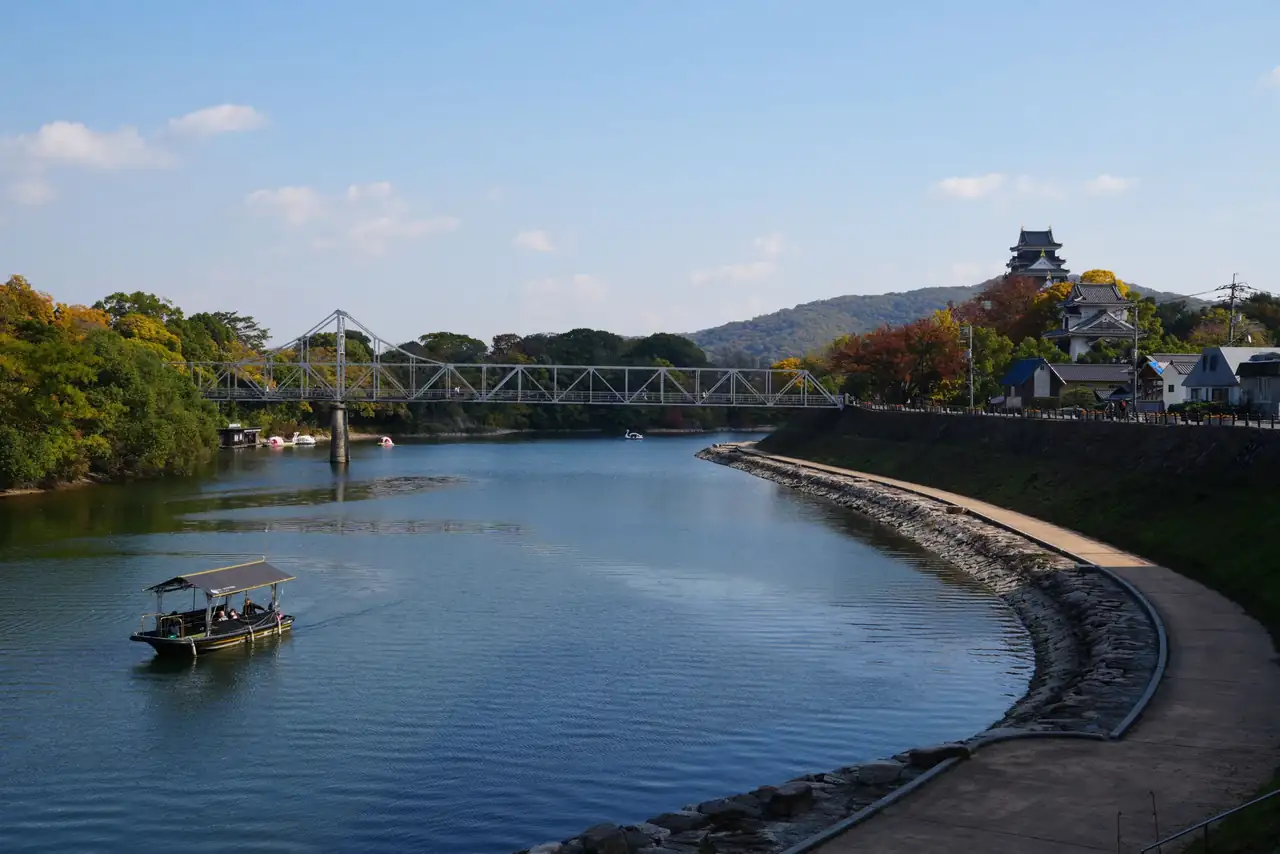
Standing directly across the Asahi River from Kōraku-en, Okayama Castle was constructed between 1573 and 1597 by warlord Ukita Naoie and his son Hideie. In stark visual contrast to the brilliant white plaster of nearby Himeji Castle, Okayama Castle is renowned for its dark, black-lacquered wooden siding panels, earning it the enduring moniker U-jō ("Crow Castle"). The tower was also designed with an unusual, asymmetric five-story, six-level pentagonal foundation, engineered to conform to the natural bend of the riverbank.
Although the original keep was destroyed during World War II, the exterior was faithfully rebuilt in 1966 and underwent a comprehensive historical renovation in 2022. The interior features interactive exhibits on Sengoku military history, authentic samurai armor displays, and hands-on craft workshops where visitors can try their hand at making Bizen pottery. The sole surviving original sixteenth-century structure on the grounds is the Tsukimi-yagura (Moon-Viewing Turret), which survived the wartime bombings intact.
3. Drift the Willow-Lined Canals of Kurashiki Bikan Historical Quarter
Located just fifteen minutes west of Okayama Station by local train, the Kurashiki Bikan Historical Quarter preserves an exceptionally intact merchant canal district dating from the early Edo period. Kurashiki operated as a Tenryō (a prosperous territory governed directly by the Tokugawa Shogunate), functioning as the primary collection and distribution depot where tax rice harvested across the Bitchū plains was loaded onto cargo barges bound for Osaka and Edo.
The district centers along the tranquil Kurashiki River, flanked by weeping willow trees, arched stone bridges, and two-story merchant residences. The buildings are constructed in distinctive namako-kabe style: brilliant white fireproof plaster walls finished along their lower halves with square black ceramic tiles sealed with rounded white mortar grids that resemble sea cucumbers (namako). Board traditional wooden flat-bottomed punting boats navigated by bamboo-poled boatmen for a gentle cruise down the canal, and explore restored wooden storehouses (kura) converted into denim boutiques, tea salons, and glassware shops.
4. Discover Western Masterpieces at the Ohara Museum of Art
Standing prominently along the Kurashiki canal behind imposing Greco-Roman neoclassical stone pillars, the Ohara Museum of Art is an extraordinary cultural institution. Founded in 1930 by local textile industrialist Magosaburō Ohara to honor painter Torajirō Kojima, it holds title as the very first museum of Western art established in Japan.
Despite being located in a provincial merchant quarter, the permanent collection rivals major global institutions, displaying world-renowned masterpieces: El Greco’s iconic The Annunciation, Claude Monet’s Water Lilies (purchased directly from Monet's Giverny studio by Kojima), alongside works by Picasso, Gauguin, Modigliani, Rodin, and Jackson Pollock. The adjacent Japanese Annex showcases twentieth-century masters of the Mingei folk craft movement, including woodblock prints by Shiko Munakata and ceramics by Shoji Hamada and Bernard Leach.
5. Scale the Mountain Clouds to Bitchū Matsuyama Castle
Perched high atop the craggy granite peak of Mount Gagyū 430 meters above sea level in Takahashi, Bitchū Matsuyama Castle is an architectural and historical marvel. It is the highest-elevation castle in Japan among the twelve surviving original wooden keeps, and the only authentic mountaintop fortress (yamajiro) that still retains its original Edo-period keep.
Constructed in 1240 and extensively fortified in 1683 by Mizunoya Katsutaka, the two-story wooden keep incorporates natural, sheer granite cliffs directly into its defensive dry-laid stone foundation walls. The castle is celebrated nationwide as a "Castle in the Sky" (Tenkū no Shiro): on clear, cool autumn mornings from October through December, a dense sea of fog (unkai) rolls across the Takahashi River basin at dawn, causing the mountaintop stone keep to appear as though it is floating on a sea of white clouds. The castle has also achieved modern fame for its resident "Cat Lord" (Sanjūrō), an affectionate feline that was adopted by the local tourism association as the castle's official mascot.
6. Walk the Red-Ochre Townscape of Fukiya Furusato Village
Tucked deep into the rugged mountain valleys of Takahashi, Fukiya Furusato Village is a remarkably unified heritage settlement that once generated extraordinary wealth through the mining of copper and the production of Bengara (red iron oxide pigment). From the Edo period through the early twentieth century, Fukiya held a virtual national monopoly on this vibrant rust-red pigment, used across Japan to coat lacquerware, shrine torii gates, and high-end ceramics.
What makes Fukiya breathtaking is its architectural uniformity: wealthy merchant families hired master carpenters from Shimane to construct their estates simultaneously, using local cedar wood stained with bengara oil, paired with custom red-tinted ceramic roof tiles (Sekishū-gawara). The result is a town of warm, terracotta-red hues nestled against dark green mountain forests. Tour the expansive Hirokane Residence—a palatial hilltop compound resembling a fortress—and try hands-on bengara fabric dyeing in village craft workshops.
7. Browse 1,000 Years of Earth and Fire at Bizen Pottery Village (Imbe)
Located in eastern Okayama around JR Imbe Station, Bizen is the oldest of Japan’s "Six Ancient Kilns" (Rokkoyo), boasting an uninterrupted ceramic tradition spanning over one thousand years. Unlike modern porcelain or glazed ceramics, authentic Bizen-yaki (Bizen ware) uses completely unglazed, iron-rich alluvial clay harvested from local rice paddies, fired in wood-burning climbing kilns (noborigama) for up to two weeks using Japanese red pine (akamatsu) logs.
The pottery's surface patterns are created entirely through serendipitous interactions between clay, intense heat (up to 1,200°C), flying wood ash, and charcoal coals inside the kiln:
- Hidasuki (Fire Marking): Brilliant scarlet and orange ribbon patterns created by wrapping straw soaked in saltwater around the clay before firing.
- Goma ("Sesame Seed"): Molten pine-wood ash that settles on the vessel shoulders during firing, melting into a natural greenish-yellow glass glaze.
- Sangiri: Smoky grey-and-black metallic hues produced where pieces are buried under embers in oxygen-starved zones.
Wander past historic brick chimneys, climbing kilns, and dozens of master artisan studios along Imbe’s narrow alleys to browse cups, plates, and vases prized by tea ceremony masters for their earthy, indestructible durability.
Okayama Food Culture: The Fruit Kingdom, Barazushi & Demi-Katsu
Blessed with mild, sunny weather, deep river basins, and the nutrient-dense waters of the Seto Inland Sea, Okayama’s culinary landscape balances luxury orchard harvests with comforting B-grade soul food:
- The Fruit Kingdom (Shimizu White Peaches & Muscat Grapes): Okayama is hailed as the premier fruit bowl of Japan. Local growers pioneered delicate cultivation techniques: every individual Shimizu White Peach is wrapped by hand in a multi-layered protective paper bag while still on the tree branch, ensuring the skin remains ivory-white and shielded from direct sunlight. The resulting fruit features a perfume-like floral aroma, ultra-soft texture, and dripping sweet nectar. From late summer through autumn, orchards harvest world-renowned grapes: the emerald Shine Muscat (eaten whole with crisp, sweet skin) and the dark purple Pione (giant seedless grapes). Savor them fresh or featured in towering fruit parfaits along Okayama City’s designated "Parfait Street."
- Okayama Barazushi (The Clandestine Feast): Okayama’s most historic and celebratory dish. In the early Edo period, frugal daimyo Ikeda Mitsumasa issued a strict sumptuary law commanding commoners to restrict their meals to "one soup and one side dish" (Ichi-jū Issai). To circumvent this decree without breaking the law, clever local townsfolk mixed over a dozen seasonal delicacies—fresh seafood from the Seto Inland Sea (Spanish mackerel, eel, shrimp, octopus) and mountain vegetables (burdock, lotus root, shiitake)—into a single large bowl of seasoned vinegared sushi rice, insisting it was technically only "one dish." Today, Barazushi remains a lavish, multi-layered banquet dish served at regional festivals.
- Demi-Katsu Don: Okayama City’s signature soul food, invented in 1931 at the historic restaurant Nomura near the castle moats. Unlike standard Japanese katsudon (which simmers breaded pork cutlets with dashi, soy sauce, and egg), Demi-Katsu features a thick, freshly fried panko pork cutlet served over a steaming bowl of white rice and shredded green cabbage, smothered in a rich, deeply savory, dark-brown Western demi-glace sauce simmered with beef stock, red wine, and vegetables.
- Tsuyama Horumon Udon: A beloved B-grade comfort food originating in the northern livestock hub of Tsuyama. Plump, succulent pieces of fresh beef offal (horumon—including intestines, tripe, and hearts) are stir-fried on scorching iron teppan griddles alongside thick, chewy udon noodles, onions, and spring cabbage, bound together in an intensely savory, sweet-spicy garlic-and-miso tare sauce.
- Mamakariba (Sardinella Sashimi): A tiny, silvery coastal fish (small sardinella) caught along the Seto Inland Sea. The name literally means "borrowing rice" (mama = rice, kari = borrow): because the pickled fish is so delicious, diners eat through their entire supply of white rice and must knock on their neighbor's door to borrow more. Typically served lightly pickled in sweet rice vinegar with kelp and chili, or flash-grilled over charcoal with coarse salt.
- Kibi Dango: The legendary sweet of the Momotarō folk tale. Originally a humble millet flour cake eaten by peasants, nineteenth-century confectioners refined it into delicate, bite-sized, pillowy dumplings made from sticky sweet glutinous rice flour (mochigome) lightly dusted in starch. Sold in beautifully illustrated Momotarō packaging throughout Okayama Station.
Transportation: Shinkansen Hub & Nostalgic Streetcars
Okayama boasts exceptional transportation infrastructure, serving as western Honshu’s primary high-speed rail interchange connecting Honshu directly to Shikoku:
- Tokaido / Sanyō Shinkansen Spine:
- JR Okayama Station is a primary high-speed terminal where every single Shinkansen train (Nozomi, Mizuho, Sakura, Hikari, and Kodama) stops.
- High-speed bullet trains link Okayama directly to Shin-Osaka in 45 minutes, Kyoto in 60 minutes, Hiroshima in 35 minutes, and Tokyo in roughly 3 hours and 15 minutes. (Fully covered by nationwide and regional JR rail passes).
- Gateway to Shikoku (The Great Seto Bridge Line):
- From Okayama Station, the JR Seto-Ōhashi Line (Marine Liner Rapid) departs every 30 minutes, crossing the double-decker Great Seto Bridge directly to Takamatsu in Kagawa Prefecture in just 53 minutes.
- Limited express trains (Shiokaze and Nanpū) also link Okayama directly to Matsuyama (Ehime) and Kōchi without transfers.
- Connecting Okayama to Kurashiki:
- Frequent local commuter trains on the JR Sanyō Main Line and Hakubi Line connect JR Okayama Station to JR Kurashiki Station in just 15 to 17 minutes for ¥330. From Kurashiki Station's South Exit, the Bikan Historical Quarter is a pleasant, flat 10-minute walk through a covered pedestrian shopping arcade.
- Okayama Electric Tramway (Streetcars):
- Operating from the east plaza of Okayama Station, two vintage streetcar lines (Higashiyama Line and Seikibashi Line) run every 5 minutes. The Higashiyama Line drops visitors at Shiroshita Stop (approx. 5 minutes, ¥140), just steps from the entrances of Okayama Castle and Kōraku-en Garden.
- Digital Transit Cards (IC Cards): JR lines, Okayama streetcars, and regional buses fully accept digital Suica, Pasmo, and ICOCA cards loaded on smartphones. Simply tap your phone across the ticket barriers.
Where to Stay in Okayama: Strategic Base Camps
| Base Hub | Vibe & Atmosphere | Transit Connections | Accommodation Strategy |
|---|---|---|---|
| JR Okayama Station Area | Modern commercial transit hub, sprawling multi-level shopping malls, rapid Shinkansen access. | Shinkansen lines; JR regional lines (to Kurashiki, Shikoku, Bizen); streetcar terminus. | High density of modern, efficient Japanese business hotels (multiple central APAs), upscale railway towers, transit properties. |
| Kurashiki Bikan Historical District | Atmospheric Edo-period canal serenity, willow-lined stone bridges, peaceful evening walks once daytime visitors depart. | JR Kurashiki Station (15 mins from Okayama). | Historic wooden ryokans, renovated traditional storehouse (kura) boutique hotels, stylish design apart-hotels. |
| Yubara Onsen (Mimasaka Highlands) | Secluded mountain river valley, therapeutic geothermal waters, traditional rural hot spring calm. | Highway buses from Okayama Station; rental car recommended. | Traditional hot spring ryokans featuring private open-air mineral baths and multi-course Chiya wagyu beef dining. |
| Kojima (Kurashiki South) | Seaside coastal harbor, denim craft workshops, panoramic views across the Great Seto Bridge. | JR Seto-Ōhashi Line (Marine Liner). | Oceanfront resort hotels, coastal lifestyle guesthouses overlooking Seto Inland Sea islands. |
Regional Day Trips Across Okayama Prefecture
1. Kojima Jeans Street: The Birthplace of Japanese Denim
Located in the southern coastal port of Kojima in Kurashiki, Kojima Jeans Street is a global Mecca for denim connoisseurs. When traditional domestic textile industries shifted in the 1960s, Kojima artisans mastered indigo dyeing, shuttle-loom weaving, and vintage distressing techniques to produce the very first domestically manufactured jeans in Japan (Big John, 1965).
Today, the street is strung with pairs of blue jeans fluttering overhead like festival banners, lined with over thirty independent artisan denim ateliers and custom tailor shops (such as Momotaro Jeans and Pure Blue Japan). Connoisseurs travel from around the world to purchase premium selvage denim hand-woven on vintage Toyoda automatic looms. While strolling, snack on local indigo-dyed blue soft-serve ice cream and blue steamed pork buns.
2. Mount Washū (Washuzan) & The Great Seto Bridge Panorama
Rising abruptly out of the coastal pine forests at the southern tip of Kojima, Mount Washū earned its name because its rocky ridgeline resembles the sweeping wings of a soaring eagle (washu). The summit observation decks look out over the Seto-Ōhashi (Great Seto Bridge)—a colossal series of double-decker suspension, cable-stayed, and truss bridges spanning 9.4 kilometers across five islands to Shikoku.
Arrive in the late afternoon to witness one of Japan's Top 100 Sunsets: the sun drops into the Seto Inland Sea, silhouetting dozens of fishing boats and green pine islets against the glowing steel towers of the bridge, before the bridge cables illuminate against the dark sea.
3. Kibitsu Shrine: The Legend of Momotarō
Situated in the quiet rural plains of Kibi west of Okayama City, Kibitsu Shrine is the spiritual heart of the ancient Kibi Kingdom, dedicated to Prince Kibitsuhiko-no-Mikoto—the historical military hero who inspired the Momotarō legend by defeating the ogre Ura. The monumental main hall and prayer hall (designated a National Treasure) were rebuilt in 1425 in an extraordinary, one-of-a-kind architectural style known as Kibitsu-zukuri, featuring a massive, interlocking twin-gabled dark cypress-bark roof.
Extending behind the main hall is a magnificent, 360-meter-long covered wooden corridor that follows the natural contours of the hillside in a straight line through manicured hydrangeas and cherry groves. At the terminus of the corridor sits the Okama-den, home to the ancient Narukama Shinji (Singing Cauldron Divination): a Shinto ritual where a bronze cauldron over a hearth emits a deep, eerie humming vibration through boiling rice and steam, used by priests since the medieval era to foretell whether a petitioner's prayer will be granted.
Best Seasons to Visit Okayama
- Spring (Late March to Mid-April): A splendid season of cherry blossoms. Somei-yoshino trees bloom along the weeping willow canals of Kurashiki Bikan, the riverbanks of the Asahi River outside Kōraku-en, and the stone terraces of Tsuyama Castle (Kakuzan Park), where over five thousand cherry trees create one of the premier sakura spectacles in western Japan. Temperate sightseeing weather averages 14°C to 19°C (57°F–66°F).
- Summer (Late June to August): The peak season for The Fruit Kingdom. Orchards across the prefecture harvest delicate Shimizu White Peaches from early July through mid-August, followed by sweet Muscat and Pione grapes. While days can be warm (averaging 31°C to 33°C / 88°F–91°F), Okayama's dry climate makes exploring manageable. In August, Kōraku-en and Okayama Castle host the magical Genso Teien (Garden of Dreams) evening illuminations, lighting the lawns and waterways with thousands of candles and lanterns.
- Autumn (October to Late November): The premier season for weather and visual drama. Crisp, clear skies, low humidity, and pleasant daytime temperatures (15°C–20°C / 59°F–68°F). The maple and ginkgo groves of Kōraku-en turn brilliant shades of crimson and gold, while early morning fog conditions make October through December the optimal window to photograph Bitchū Matsuyama Castle floating above the sea of clouds.
- Winter (December to February): Cool, crisp, and predominantly sunny. Thanks to the protective Chūgoku and Shikoku mountain barriers, southern Okayama receives virtually zero snow and enjoys abundant winter sunshine, with temperatures averaging 3°C to 11°C (37°F–52°F). On the third Saturday of February, Saidai-ji temple in Okayama City hosts the legendary Saidai-ji Eyo (Hadaka Matsuri / Naked Man Festival), where nearly ten thousand men wearing only white loincloths battle in darkness to catch two sacred wooden talismans (shingi) tossed by the chief priest to secure a year of good fortune.


 広島
広島 島根
島根 鳥取
鳥取 山口
山口