

On this page
Ehime Travel Guide: Ancient Imperial Springs, Hilltop Keeps & Island Cycling
Occupying the northwestern flank of Shikoku along the tranquil, island-speckled currents of the Seto Inland Sea and the Uwa Sea, Ehime Prefecture (愛媛県) is a storied realm of maritime commerce, samurai fortresses, and literary romance. Historically known as Iyo Province, the name Ehime originates from classical Shinto mythology in the eighth-century Kojiki, personifying the land as Ehime no Mikoto—the "Lovely Maiden Princess." To the south and east, the prefecture is sheltered by the jagged spine of the Shikoku Mountain Range, culminating in Mount Ishizuchi (1,982m), the highest peak in western Japan; to the north, its coast slopes down into emerald citrus orchards and sheltered maritime straits.
Ehime holds a monumental position in Japanese cultural history. It is home to Dōgo Onsen, celebrated alongside Arima and Shirahama as one of Japan's three oldest hot spring resorts, with documentation dating back over three millennia to visits by mythical deities and Yamato emperors. Its capital, Matsuyama, developed around one of the country's most formidable surviving hilltop keeps and inspired Natsume Sōseki’s classic novel Botchan. Offshore, Ehime's coastal straits were historically ruled not by warlords, but by the Murakami Suigun—a legendary independent maritime pirate clan that controlled sea traffic through naval prowess. Today, that maritime heritage is connected to Honshu via the world-renowned Shimanami Kaidō, an engineering masterpiece of suspension bridges that serves as the premier ocean-cycling route on earth. Connected by JR limited express lines and regional air hubs, Ehime provides a relaxed and rewarding escape into Shikoku's coastal soul.
Navigating Ehime Prefecture: Core Geographic Sectors
Because the Shikoku mountain spine arcs across the interior, Ehime divides into three distinct historical regions (Tōyo, Chūyo, and Nanyo):
| Sector | Primary Station Hubs | Landscape & Atmosphere | Key Highlights |
|---|---|---|---|
| Matsuyama & Chūyo Core | JR Matsuyama / Matsuyama City (Shi-eki) / Dōgo Onsen | Historic castle capital, vintage electric streetcars, three-thousand-year-old hot springs, literary cafes. | Matsuyama Castle, Dōgo Onsen Honkan, Dōgo Giyaman Glass Museum, Bansuisō French villa, Ishite-ji Temple. |
| Shimanami & Tōyo (Northeast) | JR Imabari / Niihama / Saijō | Colossal ocean suspension bridges, island cycling paths, pirate fortress straits, master towel weaving centers. | Shimanami Kaidō cycling route, Kurushima Kaikyō Bridge, Kirosan Observatory, Imabari Castle, Mount Ishizuchi. |
| Uchiko, Ōzu & Nanyo (Southwest) | JR Uchiko / Iyo-Ōzu / Uwajima | Preserved Edo wax-merchant townscapes, cliffside river villas, rare original wooden keeps, bullfighting arenas. | Uchiko Yokaichi preservation district, Garyū Sansō, Ōzu Castle (wooden keep stay), Uwajima Castle, Nanrakuen Garden. |
Top Things to Do Across Ehime
1. Bathe in 3,000 Years of History at Dōgo Onsen Honkan
Celebrated as the oldest documented thermal spring in Japan, Dōgo Onsen is mentioned in the ancient Nihon Shoki chronicles and the Man'yōshū poetry anthology. According to local folklore, the spring was discovered when a wounded white egret dipped its injured leg into a cleft in the steaming rocks, emerging completely healed.
The crown jewel of the district is the Dōgo Onsen Honkan, an architectural masterpiece completed in 1894 under the direction of Dōgo town mayor Isaniwa Yukiya and master carpenter Sakamoto Matahachirō. The three-story wooden bathhouse features complex multi-tiered gabled roofs, maze-like cedar corridors, and tatami resting rooms. Crowning the top ridge perches the Shinrokaku (White Heron Pavilion), a red-glass watchtower whose drum (Tokidaiko) is struck six times every morning, noon, and evening to sound the hours across the town. The bathhouse famously served as the direct visual inspiration for Yubaba’s bustling bathhouse in Hayao Miyazaki’s animated film Spirited Away.
Inside, bathers soak in stone-lined communal pools filled with alkaline simple thermal spring waters: the historic Kami no Yu ("Bath of the Gods") and Tama no Yu ("Bath of the Spirits"). The building also preserves the Yūshinden—the only bathhouse suite in Japan constructed exclusively for the private use of the Imperial Emperor and royal family.
---
2. Scale the Mountaintop Complex of Matsuyama Castle
Perched high on the summit of Mount Katsuyama 132 meters above the city center, Matsuyama Castle (Matsuyama-jō) is one of the grandest and most strategically complex fortresses in Japan. Constructed between 1602 and 1628 by warlord Katō Yoshiaki, it is one of only twelve surviving original castle keeps in Japan, and stands alongside Himeji and Wakayama as one of the country's three premier Renritsushiki (connected-keep) hill fortresses.
Visitors ascend the wooded mountain slopes via a scenic single-chair open lift or an enclosed aerial ropeway. Reaching the high citadel reveals an intricate defensive labyrinth of twenty-one preserved timber structures, including the massive Nohara Yagura (the only surviving original two-story turret built in the style of an early lookout tower) and fortified gates. The three-story wooden Main Keep (Tenshu) features steep internal wooden staircases, arrow slits, and warrior drop-chutes (ishi-otoshi). Climbing to the top floor provides a panoramic 360-degree vista sweeping across the Matsuyama plain out to the blue waters of the Seto Inland Sea.
---
3. Cycle Across the Sea on the Shimanami Kaidō
Connecting the coastal city of Imabari in northeastern Ehime to Onomichi in Hiroshima Prefecture, the Shimanami Kaidō (Nishiseto Expressway) is universally celebrated as one of the world's greatest bicycle touring routes. Stretching approximately seventy kilometers, this highway traverses six rural islands across the Seto Inland Sea via a series of colossal suspension, cable-stayed, and arched bridges.
Unlike standard highway bridges that exclude pedestrians, every single span along the Shimanami Kaidō was engineered with dedicated, gently graded, separate ramps for cyclists and walkers. The route is marked by an unbroken blue navigation line painted onto the pavement, linking rental bicycle terminals where travelers can pick up road bikes, cross bikes, or electric-assist e-bikes and drop them off at terminals across the islands.
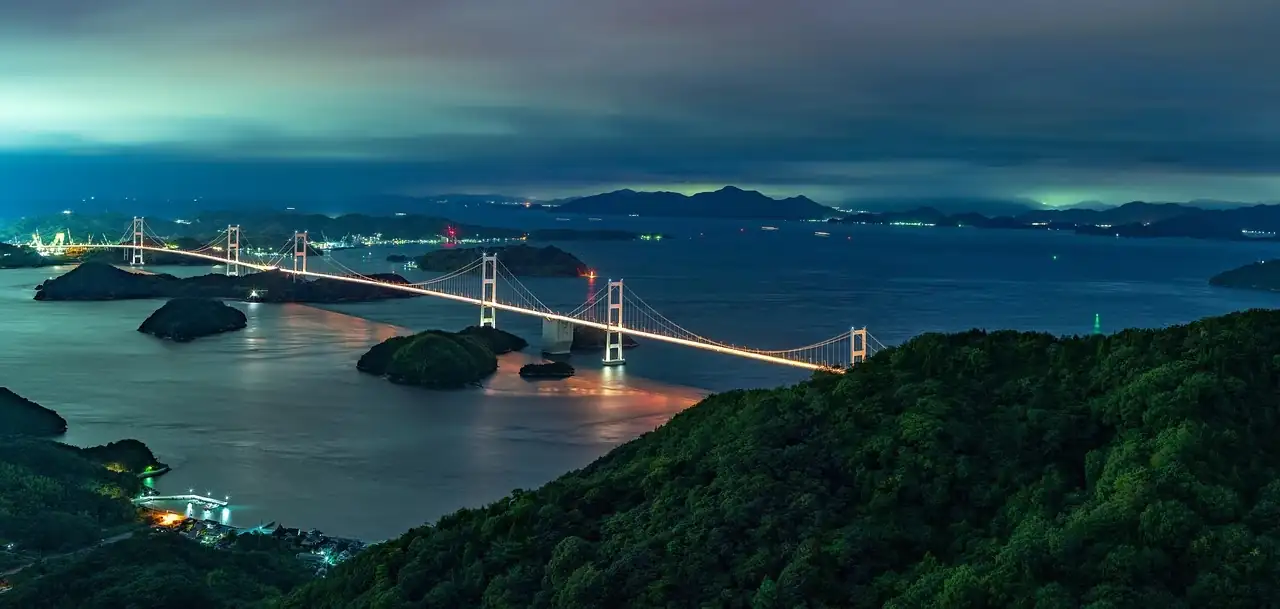
The definitive engineering highlight is the Kurushima Kaikyō Bridge—the world's first triple-suspension bridge structure, spanning over four kilometers across treacherous tidal currents at the mouth of Imabari Harbor. Climb up to the Kirosan Observatory on Ōshima Island (designed by architect Kengo Kuma, embedded invisibly into the mountain crest) to gaze down across the white bridge towers and emerald shipping straits.
---
4. Step into the Gilded Wax Era in Uchiko
Nestled in a peaceful mountain river basin forty minutes southwest of Matsuyama, Uchiko was a booming industrial center during the late Edo and Meiji eras. The town held a global reputation for manufacturing high-grade Mokurō (Japanese vegetable sumac wax), exported worldwide to coat candles, matches, and cosmetics.
Today, the Yokaichi-Gokoku Preservation District preserves a 600-meter-long cobblestone merchant avenue lined with over one hundred traditional townhouses and storehouses. The buildings are characterized by distinctive pale cream-and-ochre wax plaster walls (asagi-tsuchi), overhanging wooden eaves, and heavy merchant gates. Tour the palatial Kamihaga Residence to explore how sumac berries were pressed into pure white wax, and visit the Uchiko-za Theater—a magnificent, two-story wooden Kabuki playhouse constructed in 1916, complete with a manual revolving stage, trapdoors, and tatami box seating.
5. Gaze Across the River Bluff at Garyū Sansō (Ōzu)
Perched on a sheer cliff high above a scenic bend of the Hiji River in the castle town of Ōzu, Garyū Sansō is an exquisite sukiya-style villa and garden completed in 1907 by wealthy tea connoisseur Torajirō Kōchi, who spent ten years designing the estate. Spanning roughly 9,900 square meters, the villa blends residential shoin carpentry with rustic tea-house aesthetics.
Wander down moss-carpeted stone footpaths to the Furo-an (Bathing Hermitage), an airy wooden pavilion cantilevered directly over the river cliff, supported by living timber stilts. The pavilion is engineered with an arched, basket-woven ceiling made from unpeeled bamboo; on clear moonlit nights, moonlight reflects off the running river current below, bouncing upward to illuminate the ceiling with rippling patterns of water light.
6. Explore Esoteric Mysteries at Ishite-ji (Temple 51)
Located on the eastern outskirts of Matsuyama, Ishite-ji ("Stone Hand Temple") is Temple 51 of the famous 88-Temple Shikoku Pilgrimage (Ohenro). Unlike conventional Buddhist compounds, Ishite-ji is an eccentric, sprawling sacred site that blends Shingon esoteric doctrine with folk mysticism and outdoor spiritual installations.
Visitors pass through the magnificent two-story Niōmon Gate (constructed in 1318, a designated National Treasure) to view a three-story Kamakura-period wooden pagoda. Behind the main hall, visitors enter the Mantōkutsu (Cave of Ten Thousand Lamps)—a dark, 200-meter-long winding subterranean tunnel carved through the mountain rock, illuminated only by candles and small lanterns, lined with hundreds of carved stone Jizō statues. The tunnel emerges on the other side of the hill into the surreal "Inner Sanctuary," filled with wooden pagoda sculptures and oversized golden Buddhist art.
7. Scale the Last Unaltered Wooden Bastion: Uwajima Castle
Rising high atop a wooded hill in deep southwestern Ehime, Uwajima Castle is another of Japan's twelve surviving original castle keeps. Commissioned by master fortress architect Tōdō Takatora in 1596 and rebuilt in 1666 by Date Munetoshi (son of Date Hidemune of the famous Sendai Date clan), the castle was ingeniously designed with an irregular five-sided (pentagonal) perimeter moat, which created optical illusions that confounded attacking samurai commanders who presumed standard square fortifications.
The compact, three-story wooden keep retains its original sixteenth-century interior timber framing, polished wooden plank floors, and carved defensive gunports. The hilltop bailey offers sweeping views across Uwajima Harbor and the pearl-farming rafts floating in the sheltered coves of the Uwa Sea.
Ehime Terroir: The Citrus Empire, Tai-Meshi Rivals & Jakoten
Blessed with year-round Seto Inland Sea sunshine, mild Mediterranean-style coastal breezes, and rich maritime fishing channels, Ehime boasts a vibrant, comforting culinary identity centered on fruit mastery and fresh coastal catch:
- The Citrus Kingdom (Ehime Mikan & Kanpei): Ehime is universally recognized as the Citrus Capital of Japan, cultivating more than forty distinct commercial citrus varieties. The region benefits from what locals call the "Three Suns": direct sunlight from the clear sky, sunlight reflected off the ocean water, and heat reflected up from dry stone terrace walls.
- Varieties: From sweet, easy-to-peel Unshū Mikan in autumn to luxury hybrids like Beni Madonna (featuring an ultra-thin skin and a texture resembling sweet fruit jelly) and Kanpei (crisp, juicy pulp with high sugar content).
- Mikan Juice Faucets: A legendary urban myth made real. Throughout Matsuyama (including Matsuyama Airport, Dōgo Onsen shops, and tourist centers), visitors can turn on real brass faucets to pour cups of freshly chilled, 100% pure mikan juice on tap.
- The Two Great Styles of Tai-Meshi (Sea Bream Rice): Sea bream (Tai) is the official prefectural fish of Ehime, harvested from the turbulent, oxygen-rich currents of the Kurushima and Hoyo straits. Ehime features two completely distinct, competing regional preparations of Tai-Meshi:
- Matsuyama Tai-Meshi (East/Central Style): An entire fresh red sea bream is seasoned with salt and soy sauce, placed whole into a heavy clay pot over a bed of polished rice and kombu kelp, and steamed together. The cooked fish is flaked with chopsticks and gently folded into the savory, dashi-infused rice.
- Uwajima Tai-Meshi (South Style): A fisherman's dish originating from the southern coast. Raw, translucent sashimi slices of red sea bream are marinated in a savory dressing of sweet soy sauce, mirin, dashi, raw egg yolk, and toasted sesame seeds, then poured over a bowl of hot steamed white rice, garnished with fresh seaweed, shiso, and scallions.
- Jakoten: The ultimate coastal soul food, originating in the fishing ports of Uwajima and Yawatahama. Small, whole coastal fish (such as Hotarujako, or lantern belly) are minced whole—including skin, soft bones, and heads—into a fine paste, seasoned with salt and sugar, shaped into rectangular patties by hand, and deep-fried in vegetable oil until golden-brown. Jakoten has a slightly coarse, rustic texture and a deep, mineral-rich ocean salinity. It is best eaten hot directly from street stalls, or lightly charred over charcoal and served with grated daikon and soy sauce.
- Botchan Dango: A beloved tri-colored sweet named after Natsume Sōseki’s classic novel Botchan. Three small, chewy rice dumplings are skewered on a single bamboo stick, each coated in a different sweet bean paste: green (flavored with matcha), yellow (flavored with sweet egg yolk), and brown (sweet adzuki red bean paste). Enjoyed with green tea in teahouses throughout Dōgo Onsen.
- Imabari Yakitori: A unique style of grilled poultry native to the port town of Imabari. Instead of threading chicken onto bamboo skewers and grilling over charcoal, Imabari cooks place bite-sized pieces of skin and chicken thigh directly onto a scorching, flat iron teppan griddle, pressing the meat down firmly with a heavy cast-iron hand press (Kote). This forces excess fat out while searing the exterior to a crackling crisp in record time, finished with a sweet soy-garlic glaze.
Transportation: Regional Limited Expresses & Nostalgic Trams
Ehime is linked to Honshu via the Great Seto Bridge rail lines and an extensive coastal network of express trains and streetcars:
- Honshu (Okayama) to Matsuyama via JR Shiokaze:
- The JR Limited Express Shiokaze departs JR Okayama Station (a major Sanyō Shinkansen bullet train stop) every hour, crossing the Great Seto Bridge and tracing the northern coastline of Shikoku directly to JR Matsuyama Station in roughly 2 hours and 40 minutes. (Fully covered by the nationwide JR Rail Pass and JR All Shikoku Rail Pass).
- Matsuyama Airport (MYJ) Transit:
- Located just six kilometers southwest of downtown Matsuyama. Dedicated Iyotetsu Limousine Buses connect the airport terminal directly to JR Matsuyama Station (15 mins), Matsuyama City Station (20 mins), and Dōgo Onsen (40 mins).
- Iyotetsu City Tramway & The Botchan Ressha:
- Matsuyama City operates an extensive, charming streetcar network running five lines that link JR Matsuyama Station, the commercial hub of Matsuyama City Station (Shi-eki), Matsuyama Castle ropeway, and Dōgo Onsen.
- The Botchan Ressha: A vintage, diesel-powered replica of the nineteenth-century German steam locomotive that once chugged through the city, complete with a chiming whistle and conductors dressed in Meiji-period uniforms.
- Shimanami Kaidō Highway Express Buses:
- The Shimanami Cycle Express bus and regional highway coaches connect JR Imabari Station directly across the bridge islands to JR Onomichi and Fukuyama stations in Hiroshima Prefecture.
- Digital Transit Cards (IC Cards): JR lines around Matsuyama accept national digital Suica, Pasmo, and ICOCA cards. However, Iyotetsu streetcars and local island buses often operate on regional cards (ICOCAm / IC e-card) or require cash payments at the driver's fare box.
Where to Stay in Ehime: Strategic Base Camps
| Base Hub | Vibe & Atmosphere | Transit Connections | Accommodation Strategy |
|---|---|---|---|
| Dōgo Onsen Quarter (Matsuyama) | Historic hot spring village, steamy stone alleys, barefoot yukata strolling, literary cafes. | Iyotetsu Tram Line terminus; direct airport limousine buses. | Historic luxury hot spring (onsen) ryokans featuring private open-air mineral baths, modern boutique onsen hotels. |
| Matsuyama Station & City Core | Modern prefectural capital, covered shopping arcades, easy castle access, lively izakayas. | JR Shiokaze Express; Iyotetsu rail interchange; streetcar hub. | High density of modern, efficient Japanese business hotels (multiple central APAs), railway towers, corporate hotels. |
| Imabari & Shimanami Gateway | Coastal harbor, maritime shipyards, direct trailhead access for island bicycle crossings. | JR Yosan Line; Shimanami Kaidō bus terminal; ferry piers. | Cyclist-friendly hotels equipped with indoor bicycle racks, clean station-front business properties, coastal resort lodges. |
| Ōzu & Uchiko (Southwest) | Timeless merchant town nostalgia, lantern-lit river canyons, restored Edo storehouses. | JR Yosan Line / Uchiko Line limited express stops. | Historic merchant townhouse (machiya) villas, castle-stay accommodations (sleeping inside the wooden keep of Ōzu Castle), traditional minshuku. |
Regional Day Trips Across Ehime Prefecture
1. Mount Ishizuchi: Sacred Alpine Pinnacle
Rising 1,982 meters in southeastern Ehime, Mount Ishizuchi (Ishizuchi-san) is the highest mountain on the island of Shikoku and in all of western Japan. Revered as one of Japan's "Seven Sacred Peaks," it has been a center for mountain ascetic Shugendō practice since the seventh century. Hikers take the Ishizuchi Ropeway up to the成就 (Jōju) shrine plateau, ascending through beech forests toward the jagged summit.
The final ascent features the famous Kusari-dōba (Iron Chain Climbs)—three vertical rock walls where climbers haul themselves up sheer granite cliffs using colossal, hand-forged iron chain links anchored directly into the living rock face (gentler detour paths around the chains are available). The knife-edge ridge of Tengudake provides sweeping 360-degree views across the Shikoku mountains to the Seto Inland Sea.
2. The Towel Museum of Imabari (Ichihiro)
Located in the foothills outside Imabari, the Towel Museum (Towel Museum Ichihiro) celebrates the city's status as Japan’s undisputed towel-manufacturing capital, producing over sixty percent of the nation's towels. Imabari towels are famous worldwide for their unmatched water absorbency (governed by the strict "Five-Second Rule," requiring a fresh towel swatch to sink in water within five seconds). The sprawling museum features working industrial European looms running live on the floor, multi-story woven towel art tapestries, whimsical character exhibitions, and expansive English landscape gardens.
3. Besshi Copper Mine & "The Machu Picchu of the East"
Tucked deep into the rugged mountain ravines of Niihama in eastern Ehime, the Besshi Copper Mine was operated by the Sumitomo conglomerate from 1691 until 1973, fueling Japan’s industrial modernization. High on a mountain ridge at 750 meters elevation sits the Tōnaru Zone, where moss-draped, stone-and-brick foundations of the former processing plant and railway depot stand abandoned amidst the mountain mist, earning it the popular moniker "The Machu Picchu of the East." Visitors can ride a vintage miniature mining train and explore subterranean historical drift tunnels.
Best Seasons to Visit Ehime
- Spring (Late March to Mid-April): A splendid season of cherry blossoms. Somei-yoshino trees bloom across the hilltop baileys of Matsuyama Castle, frame the defensive sea moats of Imabari Castle, and blanket the grounds of Dōgo Park. Sightseeing temperatures are mild and comfortable, averaging 14°C to 19°C (57°F–66°F).
- Autumn (October to Late November): The premier season for cycling the Shimanami Kaidō and exploring mountain heritage. Crisp, clear skies, low rainfall, and temperate weather (15°C–20°C / 59°F–68°F). The beech and maple forests of Mount Ishizuchi and the river gorges around Garyū Sansō blaze in brilliant shades of scarlet, gold, and amber. Autumn also marks the opening of the Unshū Mikan harvest across the coastal terraced hillsides.
- Mid-October (Matsuyama & Niihama Autumn Festivals): One of the most intense and spirited festival weeks in Japan. Matsuyama hosts its famous Hachiawase (Clashing Shrines), where teams of local men intentionally ram massive, multi-ton wooden portable shrines (mikoshi) head-on into each other outside Dōgo Onsen Station. In eastern Ehime, the Niihama Taiko Festival features fifty-four colossal, gold-embroidered wheeled floats (Taiko-dai) weighing three tons each, pushed together in thunderous clashes known as Kurabe.
- Winter (December to February): Cool, crisp, and sunny. While temperatures average 4°C to 11°C (39°F–52°F), the Seto Inland Sea coast receives minimal snow and enjoys abundant winter sunshine. Winter is the definitive season to soak in the steamy outdoor waters of Dōgo Onsen, feast on bubbling hot pots of Matsuyama Tai-Meshi, and savor the peak winter harvest of luxury Beni Madonna citrus.
- Summer (July to August): Warm, breezy, and maritime, with temperatures reaching 31°C to 33°C (88°F–91°F). The calm waters of the Seto Inland Sea offer ideal conditions for sea kayaking, exploring pirate castle ruins on the islands, and enjoying evening strolls in cotton yukatas around Dōgo Onsen.


 香川
香川 高知
高知 徳島
徳島