

On this page
Shimane Travel Guide: Mythological Shrines, Black Feudal Keeps & Silver Mines
Stretching along the southwestern coastline of the Sea of Japan in the San'in region, Shimane Prefecture (島根県) is historically revered as the Land of the Gods (Kami no Kuni). Formed from the ancient provinces of Izumo in the east, Iwami in the west, and the offshore volcanic Oki Islands, this quiet, atmospheric territory serves as the mythological cradle of Shinto spiritual architecture. According to Japanese folklore, while the tenth lunar month is known throughout the rest of Japan as Kannazuki ("The Month Without Gods," because the deities leave their regional posts), in Shimane it is celebrated as Kamiarizuki ("The Month Where the Gods Gather"). Every autumn, the Yaoyorozu no Kami—the eight million spirits of the Shinto pantheon—assemble upon the shores of Izumo to deliberate human destinies, fortune, and marriage bonds.
Beyond its ancient mythological presence, Shimane preserves rare feudal fortresses, master landscape gardens, and monumental mining heritage. Its castle city, Matsue (the "City of Water"), is anchored by one of Japan’s five National Treasure castle keeps and preserves the home of author Lafcadio Hearn (Koizumi Yakumo), who introduced Japanese ghost tales to the Western world. In the western mountains, the UNESCO-inscribed Iwami Ginzan silver mine once yielded one-third of the entire global silver supply during the Age of Exploration. Further east, the Adachi Museum of Art showcases what is universally acclaimed as the most pristine traditional stroll garden on earth. For travelers seeking authentic feudal preservation and spiritual depth far from congested metropolitan tracks, Shimane is an evocative destination.
Navigating Shimane Prefecture: Core Geographic Sectors
Shimane's narrow territory extends nearly two hundred kilometers east to west between the Chūgoku Mountains and the Sea of Japan, dividing into four distinct travel corridors:
| Sector | Primary Station Hubs | Landscape & Atmosphere | Key Highlights |
|---|---|---|---|
| Matsue & Lake Shinji (East) | JR Matsue / Matsue-Shinjiko-Onsen | Moated samurai castle capital, brackish lagoon sunsets, historic samurai residences, canal punting boats. | Matsue Castle (National Treasure), Horikawa sightseeing moat cruise, Lake Shinji sunsets, Lafcadio Hearn Memorial. |
| Izumo & Spiritual Heartland | JR Izumo-shi / Izumotaisha-mae | Sacred coastal shrines, colossal straw ropes, dramatic sunset beaches, red-roofed coastal settlements. | Izumo Taisha Grand Shrine, Inasa Beach, Hinomisaki Lighthouse, Shimane Museum of Ancient Izumo. |
| Iwami & Western Heritage | JR Ōdashi / Tsuwano / Gōtsu | Preserved Edo silver-mining valleys, red-clay tile roofs (Sekishū-gawara), carp-filled hillside samurai waterways. | Iwami Ginzan Silver Mine (UNESCO), Ōmori historical townscape, Tsuwano ("Little Kyoto"), Taikodani Inari Shrine. |
| Yasugi & Mountain Valleys | JR Yasugi / Kisuki | Award-winning traditional living gardens, folk dance halls, sacred Tatara ironmaking forests, cherry riverbanks. | Adachi Museum of Art, Kiyomizu-dera Temple, Tatara Iron Sword Museum, Hii River cherry tree embankment. |
Top Things to Do Across Shimane
1. Stand in Awe Beneath the Colossal Shimenawa of Izumo Taisha
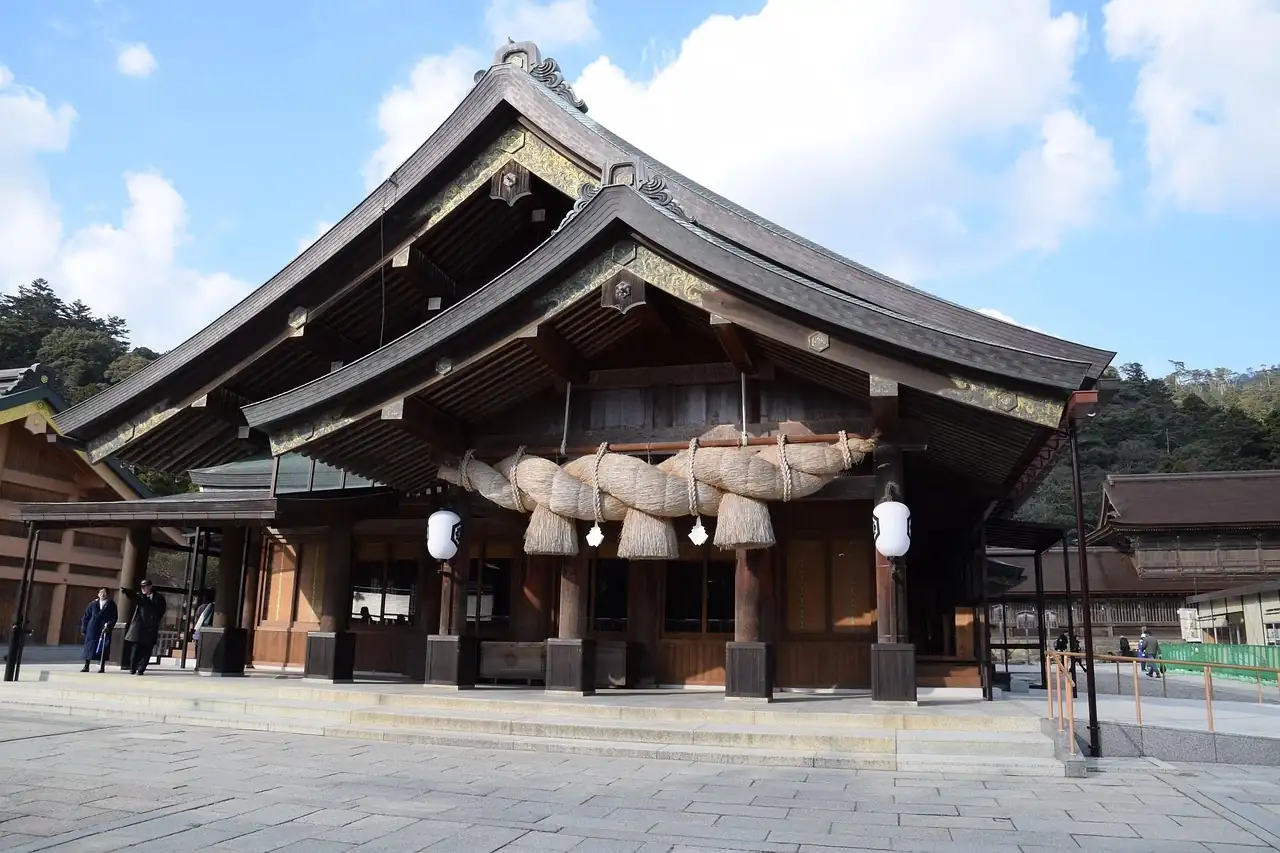
Revered alongside Ise Jingū as one of the two most sacred Shinto complexes in Japan, Izumo Taisha (The Grand Shrine of Izumo) is officially dedicated to Ōkuninushi no Ōkami, the Shinto deity of nation-building, agriculture, medicine, and En-musubi (the divine tying of relationships and human destiny). In Japanese mythology, Ōkuninushi surrendered political dominion over the land of Japan to the Sun Goddess Amaterasu on the condition that a monumental heavenly palace be erected for him at Izumo.
The shrine is approached down a sweeping, stone-paved avenue shaded by ancient pine groves. The defining architectural icon of the complex is the Kagura-den (Sacred Dance Hall), which features the largest Shimenawa (sacred rice-straw rope) in Japan. Suspended across the timber entrance, this colossal woven rope measures 13.6 meters long, eight meters in circumference, and weighs an astonishing 5.2 tons. The main sanctuary (Honden), a designated National Treasure standing twenty-four meters tall, is constructed in pure Taisha-zukuri, the oldest indigenous architectural style of Shinto shrines.
Unique Shinto Etiquette: While standard prayer etiquette across Japan dictates two bows, two handclaps, and one final bow (ni-rei, ni-hai, ichi-rei), worshippers at Izumo Taisha strictly observe four handclaps (ni-rei, yon-hai, ichi-rei)—two claps for yourself and two claps for your existing or prospective partner.
---
2. Scale the National Treasure Timber Keep of Matsue Castle
Erected between 1607 and 1611 by daimyo Horio Yoshiharu on Mount Kameda overlooking the canals of Matsue, Matsue Castle (Matsue-jō) is one of only twelve original castle keeps surviving in Japan, and one of only five designated as a National Treasure (alongside Himeji, Matsumoto, Hikone, and Inuyama). The castle earned the moniker Chidori-jō ("Plover Castle") because its multi-tiered triangular gables resemble the outspread wings of a plover bird.
In stark visual contrast to white plaster fortresses, Matsue Castle is encased in dark, black-lacquered rain-resistant wooden siding panels. The five-story (six-level) wooden keep was engineered as a formidable combat tower: it features internal defensive wells, concealed watchtowers, and a rare structural design using Tsutsumi-bashira (wrapped composite wooden pillars) bound with iron bands to support upper levels without single giant tree trunks. Climbing to the top floor (Tengu-no-ma) offers an open, 360-degree panoramic vista across the red-tiled roofs of Matsue and the shimmering surface of Lake Shinji.
---
3. Gaze Through Living Canvas Frames at the Adachi Museum of Art
Located in the countryside of Yasugi, the Adachi Museum of Art was established in 1970 by local textile entrepreneur Zenko Adachi under a guiding philosophy: "The garden is also a picture." For more than twenty consecutive years, the museum's six landscape gardens have been ranked as the Number-One Traditional Japanese Garden by the American publication Journal of Japanese Gardening, surpassing thousands of historical gardens in Kyoto and Tokyo.
Spanning roughly 165,000 square meters against the backdrop of natural forested mountains, the estate features six distinct garden styles, centered on the magnificent Dry Landscape Garden (Karesansui-teien). Visitors view the manicured gravel ripples, sculpted azalea mounds, and bonsai pines exclusively from inside climate-controlled glass pavilions. The museum features specialized window alcoves engineered as "Living Hanging Scrolls" (Ikiteiru Kakejiku) and "Living Picture Frames" (Ikiteiru Gakubuhi), where cutouts in wooden gallery walls frame the outdoor living gardens as if they were hand-painted Japanese landscape scrolls. The museum also houses over 1,500 works of modern Nihonga painting, including an extensive collection of works by master Yokoyama Taikan.
---
4. Descend into the Medieval Drift Tunnels of Iwami Ginzan
Hidden in the forested mountains of western Shimane, the Iwami Ginzan Silver Mine was established in 1526 and operated continuously for roughly four hundred years. During the sixteenth and seventeenth centuries, this single mining valley generated an estimated one-third of all the silver circulating globally, fueling Asian and European trade via the port of Tomonoura and Nagasaki. In 2007, Iwami Ginzan was inscribed as a UNESCO World Heritage site, praised for its environmentally harmonious mining practices that preserved surrounding forest ecosystems without clear-cutting.
Visitors can rent electric bicycles or walk the lush riverside forest trail to explore the Ryūgenji Mabu—one of only two historical mining shafts open to the public. The 273-meter-long subterranean tunnel features chisel marks hand-carved into the solid volcanic rock walls by medieval miners working under dim rapeseed-oil lanterns. Downvalley lies the preserved village of Ōmori, a quiet, two-kilometer-long streetscape of Edo-period magistrate residences, timber merchant houses, and historic shrines crowned by distinctive rust-red Sekishū-gawara ceramic roof tiles.
---
5. Cruise the Moats Aboard the Horikawa Sightseeing Punts
Encircling the ramparts of Matsue Castle runs a 3.7-kilometer network of natural and defensive water moats. The Horikawa Sightseeing Boat (Gurutto Matsue Horikawa Meguri) offers a peaceful, 50-minute circular cruise through these waterways aboard small, flat-bottomed wooden punts navigated by skilled local boatmen.
The cruise passes beneath sixteen historical and modern bridges. The highlight occurs when passing beneath four extremely low bridges: the boatman activates a mechanical system that lowers the boat’s entire canvas roof down to knee-level, requiring all passengers to duck forward flat against the tatami floorboards to squeeze beneath the stone girders. In winter, the boats are equipped with warm, heated Kotatsu quilt tables, allowing passengers to keep their legs cozy while sipping tea and viewing snow-covered castle walls.
6. Walk the Red Torii Tunnel of Taikodani Inari in Tsuwano
Tucked into a steep mountain valley in southwestern Shimane, the historic castle town of Tsuwano is affectionately called the "Little Kyoto of San'in." The town is famed for Tonomachi Street, a preserved samurai canal district where thousands of giant, colorful Japanese carp (nishikigoi) swim through clear stone drainage gutters running alongside white-plastered merchant walls.
Perched high on the wooded hillside above the town sits Taikodani Inari Shrine, founded in 1773 as one of Japan's Five Great Inari Shrines. Approaching the shrine requires ascending an atmospheric, winding mountain path through a dense tunnel of over one thousand bright vermilion Torii gates (Senbon Torii) that zigzag up the hillside under towering cedar trees, terminating at a grand prayer terrace overlooking the red-tiled valley below.
7. Gaze Across the Waters of Lake Shinji at Sunset
Forming the natural western boundary of Matsue City, Lake Shinji (Shinjiko) is the seventh-largest lake in Japan. Because it connects to the Sea of Japan via the Nakaumi lagoon, Lake Shinji is a brackish water lake (a mixture of fresh river runoff and ocean seawater), sustaining a rich marine ecosystem celebrated as the Shinjiko Shitchin (The Seven Delicacies of Lake Shinji).
The sunset over Lake Shinji is recognized as one of Japan's Top 100 Sunsets. Photographers gather along the lakeside promenade outside the Shimane Art Museum: as the evening sun drops toward the horizon, the sky shifts from gold to deep violet, silhouetting the solitary, pine-crested islet of Yomegashima (Bride's Island) and small wooden fishing punts against the glowing water.
Shimane Food Culture: Izumo Soba, Lake Shinji Clams & Sea Bream Rice
Influenced by Shinto banquet customs, brackish lagoon catches, and mineral-rich mountain valleys, Shimane’s culinary tradition is rustic, comforting, and deeply rooted in historical craft:
- Izumo Soba (Warigo & Kamaage): One of Japan’s Three Great Soba Styles (alongside Togakushi in Nagano and Wanko in Iwate). Unlike refined, pale buckwheat noodles where the husk is discarded, Izumo soba is stone-ground whole with the outer black buckwheat husks (Hikigurumi). This gives the noodles a dark, speckled color, an intense earthy aroma, and a firm, toothsome chew. Izumo soba is served in two distinctive regional presentations:
- Warigo Soba: Chilled noodles served in a stack of three circular, bright-red lacquered wooden bowls (warigo). Diners add condiments (grated daikon, nori seaweed, scallions) directly over the top bowl, pour a splash of concentrated dashi-soy sauce, and eat. When finished, any remaining sauce is poured down into the second bowl, continuing the sequence to the third.
- Kamaage Soba: Hot buckwheat noodles lifted directly from the boiling cauldron into a bowl alongside the cloudy, nutrient-rich cooking broth (Sobayu), seasoned with sauce and scallions to taste.
- Shinjiko Shijimi Clams: Lake Shinji yields over forty percent of all the Shijimi (basket clams) harvested in Japan. The brackish, nutrient-rich bottom waters produce plump, jet-black clams celebrated for their high concentrations of liver-nourishing ornithine. The definitive regional breakfast is Shijimi-jiru—a comforting, cloudy miso soup loaded with sweet clams, where the savory amino acids from the shells infuse the broth with deep oceanic umami.
- Taimeshi (Matsue Sea Bream Rice): A refined, aristocratic banquet dish favored by the seventh Matsue lord, Matsudaira Fumai (a legendary tea ceremony master). Unlike Ehime’s boiled whole fish, Matsue Taimeshi is an artistic, deconstructed presentation: warm steamed rice is crowned with meticulously separated mounds of minced fresh sea bream meat, riced boiled egg whites, golden egg yolks, chopped scallions, nori, and wasabi, followed by pouring a hot, clear dashi broth brewed from sea bream bones over the top.
- Nodoguro (Blackthroat Seaperch): Landed fresh at coastal ports like Hamada and Izumo, Nodoguro is a prized deep-sea white fish nicknamed the "Tuna of the White Meat" due to its rich fat content. Savor it lightly seasoned with sea salt and grilled over charcoal until the skin crisps and releases sweet oils, or enjoyed as melt-in-the-mouth raw sashimi with freshly grated wasabi.
- Shimane Wagyu (Shimane-gyū): Shimane holds an esteemed position in cattle genetics; a legendary bull named Itazakura born in Shimane in the mid-twentieth century sired bloodlines that established modern wagyu brands across Japan. Shimane Wagyu black cattle feature dense, snowy marbling with a sweet, nutty fat profile, awarded top national honors at the Wagyu Olympics.
Transportation: Regional Rail Lines & Retro Street Trains
Shimane is connected to Honshu’s major Shinkansen spines via mountain-crossing express trains, regional airport gateways, and private electric lines:
- Connecting from Okayama via JR Yakumo Limited Express:
- The primary rail lifeline to Shimane is the JR Limited Express Yakumo, departing JR Okayama Station (a major Sanyō Shinkansen bullet train stop) every hour.
- The train cuts through the scenic river gorges of the Chūgoku Mountains along the Hakubi Line, reaching JR Matsue Station in roughly 2 hours and 35 minutes, and JR Izumo-shi Station in roughly 3 hours. (Fully covered by the nationwide JR Rail Pass and JR West San'in & Okayama Area Pass).
- The Overnight Sleeper Express (Sunrise Izumo):
- For a classic journey, board the Sunrise Izumo—Japan’s last remaining daily scheduled overnight sleeper train. Departs Tokyo Station at 9:50 PM, winding westward through the night while passengers sleep in private timber cabins or carpeted Nobinobi berths, arriving at Matsue and Izumo-shi Station around 10:00 AM the following morning.
- Ichibata Electric Railway (Bataden):
- A nostalgic private electric railway running along the northern shore of Lake Shinji, connecting Matsue-Shinjiko-Onsen Station directly to Izumotaisha-mae Station (approx. 60 mins). Vintage trains click-clack past lakeside villages and rural rice paddies.
- Regional Airport Gateways:
- Izumo Airport (IZO): Known as "Izumo Enmusubi Airport," located 30 minutes by bus from Izumo-shi and Matsue. Operates daily flights from Tokyo (Haneda) and Osaka (Itami).
- Miho-Yonago Airport (YGJ): Located 45 minutes east of Matsue, offering additional domestic connections.
- Digital Transit Cards (IC Cards): Major stations along the JR San'in Main Line (Matsue, Izumo-shi) accept digital Suica, Pasmo, and ICOCA cards. However, the Ichibata Railway, rural buses to Iwami Ginzan, and regional taxis often require physical cash payments.
Where to Stay in Shimane: Strategic Base Camps
| Base Hub | Vibe & Atmosphere | Transit Connections | Accommodation Strategy |
|---|---|---|---|
| Matsue City Core | Lively castle town atmosphere, walkable canal ways, easy castle access, sunset lakeside views. | JR Yakumo Express terminus; Ichibata Railway; Lake Shinji bus loops. | High density of modern, efficient Japanese business hotels (multiple central APAs), railway towers, lakeside hot spring ryokans (Matsue Shinjiko Onsen). |
| Tamatsukuri Onsen (Matsue Suburb) | Ancient geothermal river village, cherry-lined canals, 1,300-year-old therapeutic "beautifying" waters. | JR Tamatsukuri-Onsen Station (10 mins from Matsue). | High-end traditional hot spring ryokans featuring sprawling open-air rock baths (such as Chōtenkaku) and multi-course Shimane Wagyu kaiseki dining. |
| Izumo City & Taisha Area | Sacred spiritual calm, morning walking access to Izumo Taisha before day-trip crowds arrive. | JR Izumo-shi Station; Ichibata Railway (Izumotaisha-mae). | Atmospheric traditional Japanese pilgrim inns (Ryokan) outside shrine gates, clean station-front business hotels. |
| Tsuwano (Southwest) | Quiet mountain basin nostalgia, carp-filled samurai street canals, secluded night peace. | JR Yamaguchi Line (connected to Shin-Yamaguchi Shinkansen). | Historic family-run Japanese minshuku, boutique heritage ryokans. |
Regional Day Trips Across Shimane Prefecture
1. Hinomisaki Lighthouse & Coastal Sea Cliffs
Perched on the rugged western tip of the Shimane Peninsula roughly twenty minutes past Izumo Taisha, Hinomisaki is a dramatic cape of dark volcanic basalt columns plunging into the Sea of Japan. Standing prominently on the headland is the Hinomisaki Lighthouse, constructed in 1903. Rising 43.65 meters tall, it holds title as the tallest stone masonry lighthouse in Japan and is designated an Important Cultural Property.
Visitors can climb the interior spiral iron staircase of 163 steps to the open outer gallery for sweeping 360-degree views across the crashing Sea of Japan surf. A short walk down the coastal trail leads to the vermilion timber gates of Hinomisaki Shrine and the sacred offshore islet of Fumishima, an uninhabited breeding sanctuary for thousands of wild black-tailed gulls (Umineko).
2. The Oki Islands (UNESCO Global Geopark)
Located forty to eighty kilometers off the Shimane coast in the Sea of Japan, the Oki Islands are an archipelago of four inhabited volcanic islands (Dōgo, Nishinoshima, Nakanoshima, and Chiburijima) recognized as a UNESCO Global Geopark. Formed by ancient volcanic activity and sculpted by violent sea currents, the islands served as a historical place of exile for medieval emperors, including Emperor Go-Toba.
Board passenger ferries from Matsue (Shichirui Port) to explore the Kuniga Coast on Nishinoshima, where sheer, 257-meter-tall sea cliffs (the Matengai Cliffs) plunge sheer into the turquoise ocean, framed by the natural stone sea arch of Tsūtenkyō and clifftop meadows where horses graze wild along the precipice.
3. Okuizumo & The Sacred Tatara Ironmaking Tradition
Tucked deep into the southern mountains along the Hii River, the rural region of Okuizumo is the legendary heart of Tatara (Traditional Japanese Ironmaking). For over a millennium, ironmasters used heavy clay foot-bellows furnace structures to smelt local black iron-sand and charcoal for three continuous days and nights, forging Tamahagane (Jewel Steel)—the ultra-pure, high-carbon steel used exclusively by master swordsmiths to forge traditional Japanese samurai swords (Katana).
Visit the Okuizumo Tatara Sword Museum to inspect authentic clay smelting furnaces and watch live katana-forging demonstrations by licensed swordsmiths, then ride the scenic switchbacks of the JR Kisuki Line aboard the vintage Okuizumo Orochi diesel sightseeing train crossing high timber mountain trestles.
Best Seasons to Visit Shimane
- Autumn & Kamiarizuki (October to November): The premier spiritual and seasonal highlight. In the tenth lunar month (typically falling in November), thousands of Shinto worshippers and pilgrims gather along Inasa Beach at dusk to witness the Kami Mukae Shinji (God-Welcoming Ritual), where sacred bonfires guide the arrival of the eight million Shinto deities into Izumo Taisha. Temperatures are crisp and pleasant (14°C–19°C / 57°F–66°F), while the maples of Matsue Castle and the Adachi Museum gardens blaze in crimson and gold.
- Spring (Late March to Mid-April): A splendid season of cherry blossoms. Somei-yoshino trees frame the black timber keeps and moats of Matsue Castle (ranked among Japan's Top 100 Cherry Blossom Spots), while a two-kilometer continuous tunnel of eight hundred cherry trees blooms along the embankments of the Hii River in Kisuki. Mild, comfortable sightseeing weather averaging 13°C to 18°C (55°F–64°F).
- Winter (December to February): Cool, moody, and maritime. Temperatures average 2°C to 8°C (36°F–46°F), with occasional dustings of snow that transform Matsue Castle and the thatched roofs of Izumo into monochrome Japanese ink paintings. Winter is the definitive culinary season to feast on piping-hot bowls of Kamaage Soba, savor savory pots of Lake Shinji clam soup, and cruise the castle moats inside heated Kotatsu boats.
- Summer (July to August): Warm, breezy, and coastal, with temperatures reaching 30°C to 33°C (86°F–91°F). Sea breezes make beaches like Inasa Beach and the rocky shores of the Oki Islands popular spots for coastal swimming, sea kayaking, and sunset viewing across Lake Shinji. In late July, the city of Matsue stages the Matsue Suitōro (Water Lantern Festival), illuminating castle moats and historic samurai quarters with thousands of floating handmade paper lanterns.


 広島
広島 岡山
岡山 鳥取
鳥取 山口
山口