

On this page
Mie Travel Guide: Imperial Shrines, Sacred Pilgrimages & Pearl Havens
Curving along the Pacific coastline of the Kii Peninsula in the Kansai/Tokai borderland, Mie Prefecture (三重県) holds a sacred position in the spiritual architecture of Japan. Historically divided into the ancient provinces of Ise, Shima, and Iga, this coastal and mountainous realm has drawn pilgrims for thousands of years. It is home to Ise Jingū (The Grand Shrine of Ise), the spiritual pinnacle of the Shinto faith, where the Sun Goddess Amaterasu Ōmikami is venerated as the ancestral deity of the Imperial House of Japan.
Beyond its profound spiritual core, Mie offers an extraordinary intersection of rugged geography, feudal intrigue, and coastal traditions. To the west, the isolated mountain valleys of Iga gave birth to the legendary Iga-ryū ninjutsu warriors and master haiku poet Matsuo Bashō. Along the south and east, the jagged, labyrinthine ria coastlines of Ise-Shima National Park shelter multi-generational pearl aquaculture operations pioneered by Kokichi Mikimoto and the fearless traditional free-diving women known as Ama. Farther south, the mist-shrouded mountain passes of the UNESCO-inscribed Kumano Kodō pilgrimage trails cross mossy stone staircases into sacred mountain sanctuaries. Accessible from both Nagoya and Osaka via the expansive Kintetsu rail network, Mie offers a serene look at Japan's living heritage.
Navigating Mie Prefecture: Core Geographic Sectors
Mie’s long coastline and rugged mountain interior naturally divide the prefecture into four distinct travel corridors:
| Sector | Primary Station Hubs | Landscape & Atmosphere | Key Highlights |
|---|---|---|---|
| Ise & Sacred Heartland | Iseshi / Ujiyamada | Ancient cryptomeria forests, gravel shrine approaches, wooden riverbank merchant post towns. | Ise Jingū (Naikū & Gekū), Okage Yokochō, Oharai-machi, Sarutahiko Shrine, Futami Okitama Shrine (Meoto Iwa). |
| Shima Peninsula & Toba | Toba / Ugata / Kashikojima | Intricate ria coastlines, sheltered pearl-farming bays, traditional free-diving fishing villages, ocean resorts. | Mikimoto Pearl Island, Toba Aquarium, Ago Bay viewpoints (Yokoyama Observatory), Ama diver huts (Hachiman-kamado). |
| Iga Basin (West) | Iga-Ueno / Uenoshi | Secluded inland mountain basin, high-walled samurai castle keeps, covert ninja history, haiku heritage. | Iga Ninja Museum, Iga Ueno Castle (tall stone walls), Bashō Memorial Museum, Danjiri Museum. |
| Kumano & Higashikishu (South) | Kumano-shi / Owase | Misty mountain coastal passes, ancient flagstone pilgrim paths, sheer Pacific sea arches, terraced rice valleys. | Kumano Kodō (Iseji Route - Magose Pass), Onigajō (Demon's Castle) sea caves, Maruyama Senmaida, Shishiiwa (Lion Rock). |
Top Things to Do Across Mie
1. Journey to the Heart of Shinto at Ise Jingū (The Grand Shrine of Ise)
Venerated since the third century as the most sacred Shinto shrine complex in Japan, Ise Jingū is officially composed of 125 individual Shinto shrines. For centuries during the Edo period, everyday citizens embarked on the Okage-mairi—a mass spiritual pilgrimage where millions walked hundreds of kilometers across the empire to reach Ise. The complex is split into two primary sanctuaries separated by roughly six kilometers:
- Gekū (Outer Shrine - Toyo’uke Daijingū): Dedicated to Toyo’uke no Ōmikami, the deity of agriculture, food, shelter, and industry. Pilgrims traditionally visit Gekū first, approaching through peaceful forest groves of ancient Japanese cedars and crossing over the wooden Hiyokebashi Bridge.
- Naikū (Inner Shrine - Kōtai Jingū): The spiritual summit of Shinto, dedicated directly to Amaterasu Ōmikami, the Sun Goddess. Visitors cross the monumental 100-meter-long wooden Uji Bridge spanning the crystal-clear Isuzugawa River, where worshippers step down stone steps to purify their hands and mouths directly in the river current before entering the ancient cedar grove. Within the inner sanctuary rests the Yata no Kagami (The Sacred Mirror), one of the Three Imperial Regalia of Japan.
- The Shikinen Sengū Ritual: In accordance with an ancient ritual observed for over 1,300 years, both the Naikū and Gekū main timber shrines are completely dismantled and rebuilt from scratch every twenty years on an immediately adjacent plot of land using pristine Japanese cypress (hinoki). This monumental tradition preserves ancient timber joinery techniques without modern hardware and reflects the core Shinto philosophy of renewal, impermanence, and spiritual purity.
2. Stroll Edo-Period Commerce at Oharai-machi and Okage Yokochō
Directly outside the gates of Naikū sits Oharai-machi, an authentic one-kilometer-long stone-paved approach lining the Isuzugawa River. During the Edo and Meiji eras, this street was lined with bustling inns, tea houses, and merchant stalls catering to millions of weary pilgrims. The street showcases traditional tsumairi timber architectural styles featuring gabled facades and overhanging wooden eaves.
At the center of the district lies Okage Yokochō, a meticulously preserved heritage quarter opened in 1993 to recreate the atmosphere of Ise at the height of the Edo pilgrimage era. Browse traditional craft shops selling Ise cotton and ceramics, listen to booming taiko drum performances in the central plaza, and sample freshly pounded Akafuku Mochi paired with roasted green tea.
3. Gaze Across Ago Bay from the Yokoyama Observatory
Located on the southern tip of the Shima Peninsula within Ise-Shima National Park, Ago Bay is a spectacular geological ria coastline featuring dozens of forested peninsulas, secluded inlets, and over sixty offshore islands. The bay's calm, nutrient-rich waters are dotted with thousands of floating timber rafts supporting hanging pearl-oyster nets and seaweed beds.
The premier panoramic perspective is from the Yokoyama Observatory. An elevated wooden terrace and cafe perch 140 meters above sea level, offering an unobstructed, sweeping view across the labyrinth of green peninsulas and azure waters. Visit in the late afternoon to watch the sun drop behind the Kii mountain ranges, casting golden light across the waterways.
4. Discover the Secrets of the Iga Ninja at Iga-Ueno
Tucked into a high mountain basin in northwestern Mie, the castle town of Iga-Ueno was the historical headquarters of the Iga-ryū Ninjutsu clan during the Sengoku (Warring States) period. Unlike fictional Hollywood depictions, the Iga ninja were master survivalists, stealth operatives, and intelligence gatherers who used specialized psychology, herbology, and concealed weaponry to survive political turmoil.
The Iga Ninja Museum sits within the forested grounds of Ueno Park. The complex features a restored authentic ninja residence complete with revolving secret trapdoors (donden-gaeshi), hidden sword compartments beneath floorboards, and trick ceiling escapes demonstrated live by guides in traditional garb. Below the house, an underground gallery exhibits real historical ninja weaponry—including iron throwing stars (shuriken), climbing claws (tekagi), and stealth caltrops—concluding with high-energy live tactical combat demonstrations by the Ashura ninja clan.
5. Scale the Monumental Walls of Iga Ueno Castle
Standing in the center of Ueno Park, Iga Ueno Castle (White Phoenix Castle) was built in 1585 and substantially expanded in 1611 by master fortress architect Tōdō Takatora. The castle is celebrated for possessing some of the tallest dry-laid stone walls (ishigaki) in Japan, with defensive ramparts rising roughly thirty meters sheer out of the moat below.
The elegant, three-story wooden keep houses samurai armor, daimyo weapons, and an ornate coffered ceiling decorated with paintings donated by modern artists. The castle grounds also celebrate Matsuo Bashō, Japan’s most revered haiku poet, who was born in Iga in 1644; visit the nearby Haiseiden, a circular wooden memorial hall built to resemble Bashō’s traveling attire and conical straw hat.
6. Dine with the Traditional Ama Divers of Shima
For more than two thousand years, the coastal waters of the Shima Peninsula have been worked by the Ama (Sea Women)—traditional Japanese free-divers who plunge into the ocean without scuba tanks or modern breathing equipment, relying solely on breath-control techniques to harvest abalone, turban shells (sazae), sea urchins, and seaweed.
At traditional diving huts known as Amagoya (such as Hachiman-kamado in Osatsu), travelers can sit around an open charcoal hearth (irori) inside the hut while retired and active Ama divers grill freshly harvested shellfish over glowing binchōtan embers. Listen to firsthand accounts of their dangerous underwater trade, learn about ancient protective talismans (such as the star-shaped seiman and grid-shaped dōman symbols embroidered on their white linen diving hoods), and join in traditional celebratory circle folk dances.
7. Walk the Sacred Stone Steps of Kumano Kodō (Magose Pass)
Covering the deep southern mountains of Mie, the Kumano Kodō Iseji Route is the historic pilgrimage trail that once carried pilgrims from the Grand Shrine of Ise down along the coast to the sacred three shrines of Kumano (the Kumano Sanzan). Inscribed as a UNESCO World Heritage cultural route, the Iseji passes through steep mountain ridges, dense bamboo groves, and ancient cypress forests.
The most atmospheric and accessible section is the Magose Pass (Magose-tōge). The trail features a magnificent two-kilometer medieval path paved with moss-covered natural granite flagstones that wind beneath towering Japanese cypress trees up to an elevation of 328 meters. The mossy stone paving was engineered during the Edo period with strategic drainage gutters to withstand the torrential Pacific rains of the southern Kii Peninsula.
Mie Terroir: Matsusaka Beef, Ise Ebi & Akafuku Mochi
Positioned where mineral-rich mountain runoff empties into the sheltered waters of Ise Bay and the open Pacific, Mie boasts one of the most prestigious and historic culinary traditions in Japan:
- Matsusaka Beef (Matsusaka-gyū): Alongside Kobe and Ōmi, Matsusaka beef is celebrated as one of the "Three Great Wagyu of Japan." Reared in the rural agricultural basins surrounding Matsusaka City, true Matsusaka beef is derived exclusively from virgin female Japanese Black cattle (Kuroge Washu). The cattle are raised under demanding regimens that historically included feeding with beer to stimulate appetite and regular massages with shōchū liquor to ensure even fat distribution. Matsusaka beef features an extraordinarily low fat melting point (around 17°C / 62°F), meaning the fat literally dissolves at human body temperature. Savor it at historic establishments like Wadakin, prepared as Sukiyaki: thick cuts of beef seared over charcoal in heavy cast-iron pans, seasoned simply with coarse sugar and tamari soy sauce, dipped into raw egg.
- Ise Ebi (Japanese Spiny Lobster): The undisputed king of marine delicacies along the Ise-Shima coast. Caught in gill nets among the rocky reefs of the Pacific between October and April, Ise Ebi are prized for their thick, sweet, muscular meat. Savor it raw as translucent sashimi, split down the center and grilled in its shell with soy butter over charcoal, or simmered into rich dashi miso soups that extract sweetness from the lobster shell.
- Ise Udon: The ultimate traditional pilgrim comfort food. Unlike the firm, chewy, square-cut udon of Sanuki (Kagawa), Ise Udon features extra-thick, cylindrical wheat noodles boiled for up to forty-five minutes until they become remarkably soft, pillowy, and tender—a cooking style historically engineered so that exhausted pilgrims suffering from digestive fatigue after walking hundreds of kilometers could digest the meal easily. The noodles are served with minimal liquid, resting in a shallow pool of pitch-black, highly concentrated sauce brewed from dark tamari soy sauce, dried bonito, and sardines, garnished simply with chopped green scallions.
- Akafuku Mochi: Established in 1707 along the Isuzugawa River in Oharai-machi, Akafuku is one of the most famous traditional confections in Japan. Soft, freshly pounded rice mochi cakes are hand-wrapped in a layer of smooth, sweet adzuki red bean paste (koshian). The surface of the paste is hand-shaped with three wave-like ridges, symbolizing the clear water ripples of the sacred Isuzugawa River flowing through Ise Jingū, while the white mochi hidden beneath represents the riverbed stones.
- Tekone-zushi: A historic fisherman's meal originating from the Shima Peninsula. Freshly caught Pacific skipjack tuna (katsuo) or red tuna is marinated in sweet soy sauce and mirin, then hand-tossed directly into warm, seasoned vinegared sushi rice alongside shredded shiso leaves, fresh ginger, and nori seaweed. Originally mixed by hand on fishing boats without chopstick utensils, it remains a beloved seaside staple.
Transportation: The Kintetsu Rail Network & Express Trains
Unlike most prefectures where JR trains dominate, Mie’s primary transport artery is the private Kintetsu Railway, which operates some of the finest tourist express trains in Japan:
- Reaching Ise & Shima from Nagoya & Osaka:
- From Nagoya (Kintetsu Nagoya Station): The Kintetsu Limited Express connects directly to Iseshi Station in roughly 1 hour and 25 minutes, continuing onward to Toba and Kashikojima.
- From Osaka (Osaka-Namba Station): Kintetsu Limited Express trains run directly through the mountain passes of Yamato to Iseshi Station in roughly 1 hour and 45 minutes.
- Shimakaze (Sightseeing Limited Express): Kintetsu’s flagship premium resort train. Operates once daily from Nagoya, Osaka-Namba, and Kyoto to Kashikojima, featuring private compartments, massage seats in genuine leather, panoramic observation salon cars, and a double-decker dining cafe car serving regional seafood and Matsusaka beef curry.
- Kintetsu Rail Pass: For travelers exploring Mie, the Kintetsu Rail Pass (5-Day or Plus) offers exceptional value, providing unlimited rides across all Kintetsu lines connecting Osaka, Kyoto, Nagoya, Nara, and the entire Ise-Shima region, alongside local Mie Kotsu buses.
- Navigating Ise Jingū:
- Iseshi Station / Ujiyamada Station: The jumping-off hub. The Outer Shrine (Gekū) is an easy 5-to-10-minute walk from the station.
- Connecting Gekū to Naikū: Frequent Mie Kotsu CAN Buses link the Outer Shrine to the Inner Shrine (Naikū) and Okage Yokochō in roughly 15 minutes.
- Digital Transit Cards (IC Cards): Major train stations along the Kintetsu and JR Central lines accept digital Suica, Pasmo, and ICOCA cards loaded on smartphones. Mie Kotsu local buses operating throughout Ise and Toba also support tap-to-pay IC cards at boarding and exiting doors.
Where to Stay in Mie: Strategic Base Camps
| Base Hub | Vibe & Atmosphere | Transit Connections | Accommodation Strategy |
|---|---|---|---|
| Ise City (Iseshi / Ujiyamada) | Sacred temple town tranquility, quiet evening shrine walks, immediate access to Gekū. | Direct Kintetsu and JR lines to Nagoya and Osaka; central CAN bus stops. | High density of modern, efficient Japanese business hotels (multiple central APAs), historic pilgrim inns, boutique guesthouses. |
| Toba & Shima Peninsula | Seaside coastal harbor, ocean breezes, fresh seafood morning markets, pearl island history. | Kintetsu Shima Line terminus; regional coastal ferry piers. | Luxury waterfront hot spring (onsen) resort hotels, traditional seaside ryokans with Ise Ebi dining, cliffside villas. |
| Matsusaka Core | Historic castle town atmosphere, quiet merchant avenues, the epicenter of world-class Wagyu dining. | Kintetsu and JR junction between Nagoya and Ise. | Clean, cost-effective station-front business hotels; ideal base for gourmet culinary tours. |
| Iga-Ueno (Inland Basin) | Secluded samurai mountain basin, historic castle streets, quiet ninja heritage. | Iga Railway; JR Kansai Main Line. | Atmospheric restored merchant townhouses (machiya), boutique heritage hotels, traditional minshuku. |
Regional Day Trips Across Mie Prefecture
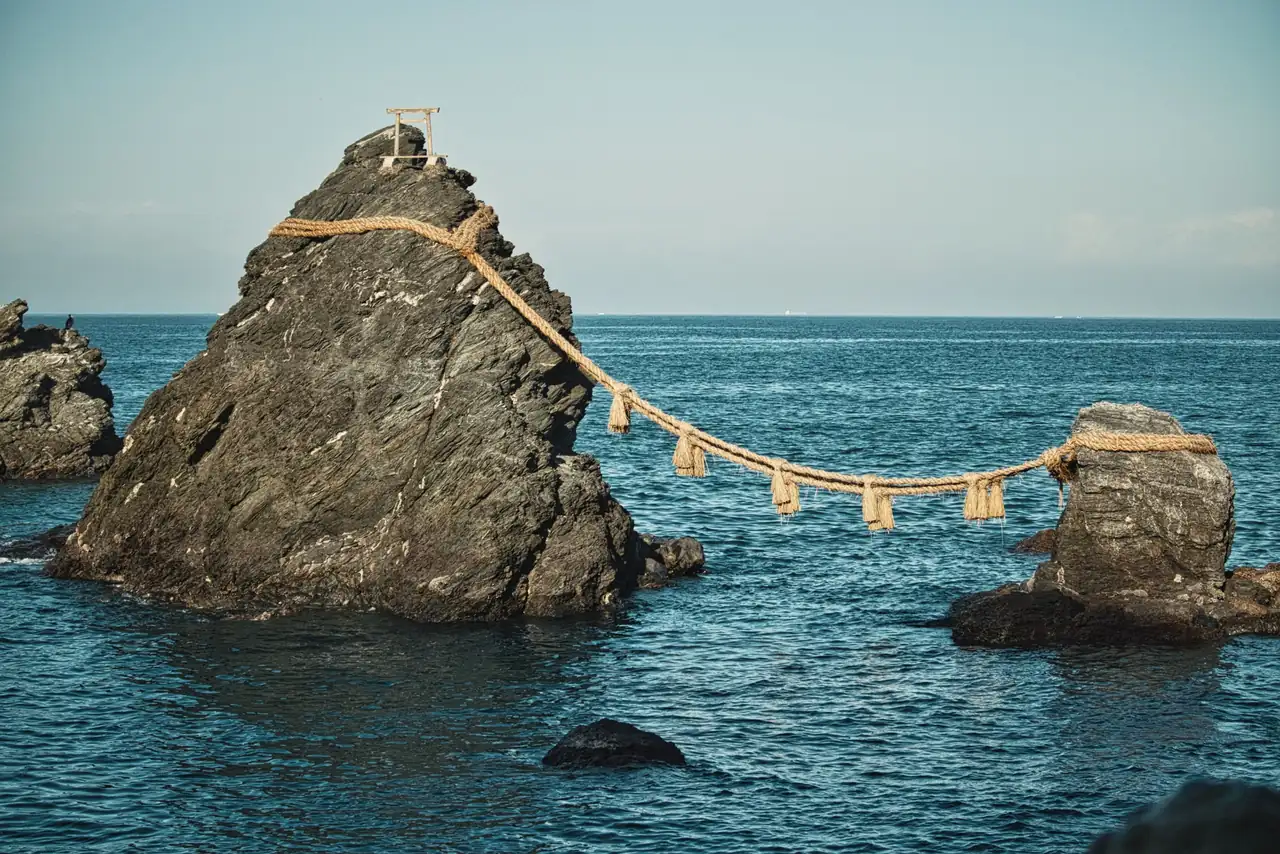
1. Futami Okitama Shrine & The Wedded Rocks (Meoto Iwa)
Located on the coastal shore northeast of central Ise, Meoto Iwa (The Wedded Rocks) are two sacred sea stacks rising out of the crashing Pacific surf. The larger rock represents the male deity Izanagi, while the smaller rock represents the female deity Izanami. The two rock pillars are bound together by five heavy sacred rice-straw ropes (shimenawa) weighing over a ton, replaced three times a year in an elaborate ritual.
Historically, pilgrims traveled to Futami first to purify themselves in the cold ocean waters before visiting the Grand Shrine of Ise. From May through July, the sunrise rises directly between the two rocks behind the sacred Mount Fuji in the far distance; during the winter full moons, the moon rises between the sea stacks.
2. Mikimoto Pearl Island (Toba)
Situated in Toba Bay, Mikimoto Pearl Island is the birthplace of modern pearl aquaculture. It was here in 1893 that Kokichi Mikimoto successfully succeeded in cultivating the world’s very first semi-spherical cultured pearl after years of trial and failure. Visitors cross a pedestrian footbridge from the mainland to tour the Pearl Museum, inspect master jewelry collections, and watch live demonstrations by traditional Ama divers wearing vintage white cotton diving robes (isogi) as they dive from wooden boats into the bay to harvest pearl oysters.
3. Maruyama Senmaida (The Thousand Rice Paddies)
Tucked deep in the rugged mountains of Kumano in southern Mie, Maruyama Senmaida is an agricultural marvel comprising 1,340 small, terraced rice paddies tumbling down a steep mountain slope. Preserved for over four centuries, it is celebrated as one of the most complex and scenic terraced rice landscapes in Japan. Because of the sharp slopes, the paddies are worked entirely by hand and stone-faced walls, reflecting timeless rural harmony with nature.
Best Seasons to Visit Mie
- Autumn (October to Late November): The premier season for weather and coastal culinary feasts. Temperatures are mild and comfortable, averaging 15°C to 20°C (59°F–68°F). The ancient cedar forests of Ise Jingū and the river gorges of the Akame 48 Waterfalls blaze in brilliant shades of yellow, gold, and crimson. Autumn marks the opening of the official Ise Ebi spiny lobster season along the Shima Peninsula.
- Spring (Late March to Mid-April): A splendid time of year. Cherry blossoms bloom along the stone ramparts of Iga Ueno Castle, the outer moats of Matsusaka Castle, and the banks of the Miyagawa River in Ise (ranked among Japan's top 100 sakura spots). Mild, refreshing sightseeing weather makes walking the stone trails of the Kumano Kodō comfortable.
- Winter (December to February): Cool, crisp, and sunny. While temperatures average 3°C to 11°C (37°F–52°F), coastal Mie receives minimal snow and enjoys clear visibility across Ago Bay. Winter brings millions of Shinto worshippers to Ise Jingū for Hatsumōde (the first shrine visit of the New Year), while oysters harvested in Toba’s Matoya Bay reach peak sweetness.
- Summer (June to August): Lush, green, and maritime. While daytime temperatures reach 32°C (90°F) with high humidity, sea breezes along the Shima Peninsula provide relief. Summer is the prime season for watching the sunrise at Meoto Iwa, exploring the cool mountain ravines of Akame, and observing the Ama divers plunging into clear waters.


 京都
京都 大阪
大阪 奈良
奈良 兵庫
兵庫 和歌山
和歌山 滋賀
滋賀