

On this page
Fukushima Travel Guide: Samurai Honor, Volcanic Color & Living Heritage
Covering over 13,700 square kilometers as the third-largest prefecture in Japan, Fukushima Prefecture (福島県) is the southern gateway to the Tōhoku region. Flanked by the Pacific Ocean to the east and the snow-draped Echigo mountains to the west, the prefecture is geographically divided by mountain ranges into three distinct cultural and climatic provinces: Hamadōri (the mild Pacific coastal strip), Nakadōri (the central agricultural and transit basin), and Aizu (the rugged, deep-snow mountainous interior).
Fukushima holds a tragic yet heroic place in Japanese history as the final bastion of the samurai era. During the Boshin War (1868–1869), the fiercely loyal samurai of the Aizu Domain made a desperate, honorable stand at Tsuruga Castle against the imperial modernization forces, immortalized in the sacrifice of the Byakkotai (White Tiger Force). Beyond its feudal legacy, Fukushima is defined by dramatic volcanic landscapes: the kaleidoscopic mineral lakes of Goshiki-numa, the crater ridges of Mount Bandai and Mount Azuma, and Lake Inawashiro (the "Heavenly Mirror Lake"). Across its valleys sit preserved thatched Edo-period post towns like Ōuchi-juku, sacred thousand-year-old weeping cherry trees, and one of Japan's most acclaimed sake brewing traditions. Sliced directly through the center by the Tōhoku Shinkansen, Fukushima offers a diverse and deeply resilient northern journey.
Navigating Fukushima Prefecture: The Three Cultural Realms
Because the Abukuma and Ōu mountain ranges divide the prefecture vertically, travel is organized around three distinct regional territories:
| Territory | Primary Station Hubs | Landscape & Atmosphere | Key Highlights |
|---|---|---|---|
| Aizu (Western Mountains) | JR Aizu-Wakamatsu / Kitakata / Yunokami-Onsen | Rugged alpine valleys, heavy winter snow, preserved samurai castle keeps, thatched post towns, ramen capitals. | Tsuruga Castle, Ōuchi-juku, Mount Bandai & Goshiki-numa, Sazae-dō, Kitakata ramen warehouses, Tadami Line rail bridges. |
| Nakadōri (Central Heartland) | JR Kōriyama / Fukushima / Shirakawa | Fertile fruit valleys, major Shinkansen transit spine, ancient weeping cherry trees, volcanic hot spring gorges. | Miharu Takizakura, Bandai-Azuma Skyline (Jōdodaira crater), Takayu Onsen, Komine Castle (Shirakawa). |
| Hamadōri (Pacific Coast) | JR Iwaki / Sōma | Mild maritime breezes, coastal fisheries, ancient thousand-horse samurai cavalry pageants, Hawaiian resort thermal spas. | Sōma Nomaoi festival, Spa Resort Hawaiians, Aquamarine Fukushima, Iwaki Shiramizu Amidadō (National Treasure). |
Top Things to Do Across Fukushima
1. Stand Before the Red-Tiled Keep of Tsuruga Castle (Aizuwakamatsu)
Originally constructed in 1384 and famously fortified by the samurai lord Gamō Ujisato in the sixteenth century, Tsuruga Castle (Aizu-Wakamatsu Castle) was the military headquarters of the Matsudaira clan during the late Edo period. The castle is legendary for enduring a grueling month-long bombardment by heavy imperial Western artillery during the Battle of Aizu in 1868, standing defiant despite being battered to its timbers.
Following a major restoration, Tsuruga Castle is the only castle keep in Japan featuring authentic red-glazed ceramic roof tiles (Akagawara). Recreated using historical Edo records, these iron-rich tiles were engineered specifically to withstand the brutal, freezing sub-zero snowstorms of the Aizu winter without cracking. Climb to the top floor of the five-story keep for sweeping views of the Aizu Basin and Mount Bandai, stroll the defensive dry-stone moats lined with over one thousand cherry trees, and sip matcha at Rinkaku Teahouse, a historic pavilion saved from destruction by samurai during the civil war.
---
2. Walk the Edo Thatched Streetscape of Ōuchi-juku
Nestled in a remote mountain river valley along the historic Aizu-Nishi Kaidō trade route, Ōuchi-juku was a thriving post town (shukuba) during the Edo period. Feudal lords (daimyo) and traveling merchants rested here during their mandatory Sankin-kōtai processions between Aizu and the shogun’s capital in Edo.
Unlike modern towns paved in asphalt, Ōuchi-juku preserves a wide, unpaved dirt thoroughfare flanked on both sides by over thirty densely clustered, single-story merchant houses topped with massive, steeply pitched thatched roofs (Kayabuki). Clear mountain spring water flows down stone drainage channels alongside the road, used by shopkeepers to cool seasonal fruits and drinks. Climb the wooden staircase at the end of the street to the mountain shrine lookout for the iconic panoramic view looking down the thatched village avenue. Inside the restored timber homes, browse folk ceramics, lacquerware, and savor local buckwheat noodles.
---
3. Gaze into the Shifting Minerals of Goshiki-numa (Five Colored Ponds)
Located on the highland plateau of Urabandai on the northern flank of Mount Bandai, Goshiki-numa (The Five Colored Ponds) is a cluster of roughly thirty volcanic crater ponds and lakes created in 1888 when a massive phreatic eruption caused the northern face of Mount Bandai to collapse, damming local river channels.
The ponds are celebrated for their vivid, surreal colors—shifting between turquoise, cobalt blue, emerald green, and copper red depending on volcanic mineral concentrations (silicates, aluminum, and iron oxide), water clarity, and sunlight angles. An easy, flat 3.6-kilometer walking trail winds through birch and pine forests connecting the primary ponds:
- Bishamon-numa: The largest lake, offering rowboat rentals on clear emerald waters framing the collapsed rugged caldera wall of Mount Bandai.
- Aonuma & Rurinuma: Intense, glowing electric-blue and milky-turquoise ponds fed by highly acidic subterranean volcanic springs.
- Akanuma ("Red Pond"): Ringed by reeds stained a deep reddish-rust hue from dissolved iron deposits.
---
4. Ascend the Double-Helix Timber Tower of Aizu Sazae-dō
Perched on the wooded slopes of Mount Iimori in Aizuwakamatsu, Sazae-dō (Entsū Sanshō-dō) is an architectural and mathematical marvel built in 1796 by the Zen Buddhist monk Ikudō. Standing 16.5 meters tall, this hexagonal wooden pagoda is named after the turban sea snail (Sazae) due to its twisted shell-like interior design.
The tower is constructed with a one-way double-helix wooden ramp: visitors walk up a gentle, sloping spiral timber walkway without stairs, cross an arched bridge at the top, and descend via a completely separate, interlocking spiral ramp without ever crossing paths with ascending visitors. In the Edo period, thirty-three carved statues of the Kannon goddess were installed along the ramps, allowing pilgrims to complete a symbolic circuit of the famous Saigoku 33 Temple Pilgrimage in a single continuous climb. Nearby on the hillside lie the graves of the Byakkotai, nineteen teenage samurai who committed ritual seppuku here during the 1868 battle after mistaking castle fires below as a sign of defeat.
5. Drive the Volcanic Ridge: Bandai-Azuma Skyline & Jōdodaira
Connecting Takayu Onsen to Tsuchiyu Pass across the volcanic peaks of the Azuma Mountain Range, the Bandai-Azuma Skyline is celebrated as one of Japan's premier alpine sightseeing highways. Reaching an elevation of 1,350 meters, the road cuts through alpine forests before entering a desolate, lunar landscape of yellow sulfuric rock, active steam vents, and barren volcanic scree.
The road reaches its crest at Jōdodaira, situated between the active volcanic vents of Mount Issaikyō and the symmetrical cinder cone of Mount Azuma-Kofuji ("Little Mount Fuji of Azuma"). Climbers can ascend a wooden staircase up to the rim of Azuma-Kofuji in fifteen minutes, walking around the complete circular volcanic crater edge for panoramic views sweeping across the Fukushima Basin below.
6. Stand Before the Ancient Cascades of Miharu Takizakura
Standing in the rolling farming hills of Miharu near Kōriyama, the Miharu Takizakura ("Waterfall Cherry Tree of Miharu") is an awe-inspiring natural living monument. Estimated to be over 1,000 years old, this colossal Beni-shidare-zakura (red weeping cherry tree) is officially designated as a National Special Natural Monument, ranked as one of the Three Great Cherry Trees of Japan.
Standing 13.5 meters tall with a trunk circumference exceeding nine meters, the tree's massive wooden branches spread twenty-five meters horizontally, supported by dozens of timber stilts. In mid-to-late April, the cascading boughs burst into millions of delicate pale-pink flowers, resembling a monumental, roaring pink waterfall cascading toward the ground. In the evening, the tree is illuminated by floodlights against the dark night sky.
7. Cross the Misty Railway Gorges of the JR Tadami Line
Winding through the deep forested mountain ravines of western Aizu along the Tadami River toward Niigata, the JR Tadami Line is internationally renowned as one of the most scenic rural railway lines in the world. The single-track diesel line crosses dozens of river bridges that span deep emerald-green waters surrounded by sheer forested cliffs.
The ultimate photographic vantage point is the Dai-Ichi Tadami River Bridge Lookout (accessible via a paved trail from the Mishima Roadside Station). Hikers climb to elevated ridge decks to watch the small, two-car green-and-white local train cross the steel arch bridge suspended high above the water. On summer mornings and autumn dawns, river fog regularly blankets the gorge, while deep winter covers the mountain bridges in several feet of pure white snow.
Fukushima Terroir: Kitakata Morning Ramen, Negi Soba & Gold Sake
Fukushima’s rich agricultural soils, pure snowmelt mountain runoff, and diverse regional climates support an acclaimed culinary tradition:
- Kitakata Ramen: The historic warehouse town of Kitakata in northern Aizu boasts the highest number of ramen shops per capita in Japan, celebrated alongside Sapporo and Hakata as one of the nation's "Three Great Ramen Styles." Kitakata noodles are flat, thick, curly, and hand-crimped, crafted with high water content (Hirauchi Jukusei Takasuimen), giving them an exceptionally bouncy, chewy texture. The soup is a clean, comforting, golden broth brewed from pork bones, dried sardines (niboshi), and local soy sauce, topped with tender melt-in-the-mouth chashu pork slices that often conceal the noodles completely.
- Asa-Rā (Morning Ramen): A unique local culture dating back to post-war factory workers and farmers. Ramen shops open as early as 7:00 AM, filled with locals eating steaming bowls of noodles for breakfast.
- Negi Soba (The Scallion Noodle Ritual): The signature culinary spectacle of Ōuchi-juku. Freshly made local buckwheat noodles are served in a bowl of chilled or warm dashi broth, accompanied not by wooden chopsticks, but by a single, thick, curved whole raw green scallion (negi). Diners use the curved scallion hook to fish the noodles into their mouth, taking bites out of the scallion as they eat to add a sharp, pungent, spicy crunch that complements the earthy buckwheat.
- Aizu Wappameshi: Originating in Aizuwakamatsu, Wappa refers to round, bentwood containers crafted from thin strips of cedar or cypress. Seasoned dashi-infused rice is placed inside the wooden container, topped with regional delicacies—wild mountain greens (sansai), sweet river salmon, mushrooms, or crab meat—and steamed together. The wood infuses the rice with a subtle, fragrant forest aroma.
- Fukushima Peaches (Akatsuki): The fertile Nakadōri basin around Fukushima City is celebrated as the "Fruit Kingdom," leading Japan in the cultivation of Akatsuki Peaches. Meticulously tended on sunlit river terraces, the fruit features a firm, juicy flesh, high sugar content, and a bright blush-pink skin, harvested from mid-July through August.
- Fukushima Nihonshu (Gold Award Winning Sake): Fukushima holds an unprecedented modern brewing record, winning the highest number of Gold Awards at the Annual Japan Sake Awards for nine consecutive competitions. Using pure mountain snowmelt, regional sake rice (Yumesansui), and distinct local yeasts, breweries across Aizu and Nakadōri (such as Daishichi, Hiroki, and Aizu-Homare) craft sakes ranging from ultra-clean, fruity Daiginjos to rich, velvety traditional kimoto-style brews.
- Aizu Basashi: Similar to Kumamoto, Aizuwakamatsu preserves a historic culture of consuming horse meat sashimi (Basashi). Unlike marbled varieties, Aizu horse meat is prized for its lean, ruby-red fillet (Akami), delivering an exceptionally tender, clean, sweet flavor without fat, eaten dipped in soy sauce mixed with a fiery local paste made from garlic, miso, and red chili pepper.
Transportation: High-Speed Rail & Mountain Scenic Lines
Fukushima serves as the primary high-speed rail corridor connecting Tokyo directly to northern Japan:
- Tokyo to Fukushima via Tōhoku Shinkansen:
- High-speed bullet trains (Hayabusa, Yamabiko, Nasuno) connect Tokyo Station directly to JR Kōriyama Station in roughly 75 minutes and JR Fukushima Station in roughly 85 minutes. (Fully covered by the nationwide JR Rail Pass and JR East Tohoku Area Pass).
- Connecting to Aizu-Wakamatsu (West):
- From JR Kōriyama Station, transfer to the JR Ban'etsu-West Line (Ban'etsu-Saisen). Rapid commuter trains cross the mountain pass past Lake Inawashiro and Mount Bandai, reaching JR Aizu-Wakamatsu Station in 65 minutes.
- To reach Kitakata, continue on the same line for an additional 15 minutes.
- Reaching Ōuchi-juku (Aizu Railway):
- From Aizu-Wakamatsu, board the scenic private Aizu Railway to Yunokami-Onsen Station (approx. 35 mins)—famous for having the only train station in Japan with a traditional thatched reed roof and working open hearth (irori).
- From Yunokami-Onsen Station, board the Sarurugō tourist shuttle bus or take a 10-minute taxi directly into Ōuchi-juku.
- Digital Transit Cards (IC Cards): Major stations along the Shinkansen and the JR line around Kōriyama and Fukushima accept digital Suica, Pasmo, and ICOCA cards loaded on smartphones. Travel Note: Rural rail lines (Aizu Railway, Tadami Line) and mountain bus routes to Goshiki-numa require physical cash or regional transit passes.
Where to Stay in Fukushima: Strategic Base Camps
| Base Hub | Vibe & Atmosphere | Transit Connections | Accommodation Strategy |
|---|---|---|---|
| Aizuwakamatsu Core | Samurai castle town atmosphere, historic sake breweries, walking distance to castle parks. | JR Ban'etsu-West Line, Tadami Line, Aizu Railway junction. | Modern Japanese business hotels (multiple central APAs), historic timber city ryokans, retro guesthouses. |
| Higashiyama Onsen (Aizu Suburb) | Secluded riverside thermal ravine, historic geisha heritage, footpaths along mountain streams. | 10-minute tourist bus (Haikara-san) from Aizu-Wakamatsu Station. | Authentic multi-story wooden hot spring (onsen) ryokans featuring private open-air rock baths (such as Mukaitaki) and multi-course Aizu kaiseki dining. |
| JR Kōriyama Station Area | Central transport junction, multi-story shopping complexes, immediate bullet train access. | Tōhoku Shinkansen; Ban'etsu-West, Ban'etsu-East, and Suigun lines. | High density of modern, efficient corporate business hotels, railway tower properties; practical base for day-tripping across all three regions. |
| Urabandai & Mount Bandai | Highland alpine nature, volcanic lake views, ski slopes, serene beech forests. | Local buses from Inawashiro Station. | Sprawling lakefront alpine resort hotels, family-run countryside pensions, luxury forest lodges. |
Regional Day Trips Across Fukushima Prefecture
1. Sōma Nomaoi: The Thousand-Horse Samurai Pageant
Held annually over the last weekend of May in the coastal Hamadōri towns of Sōma and Minamisōma, the Sōma Nomaoi is one of the most spectacular living martial heritage festivals in Japan. Dating back over one thousand years to military training exercises devised by warlord Taira no Masakado, over four hundred horsemen dressed in authentic ancestral samurai armor, battle helmets (kabuto), and wielding katanas gather for three days of martial contests.
The headline events include the Kacchū Keiba—where twelve armored samurai on horseback gallop along an outdoor track with family battle banners fluttering from their backs—and the Shinki Sōdatsusen, where hundreds of horsemen clash in an open field to catch sacred shrine banners fired high into the sky by fireworks mortars.
2. Lake Inawashiro & The Swan Shirasagi Migrations
Sitting at an elevation of 514 meters directly south of Mount Bandai, Lake Inawashiro (Inawashiroko) is the fourth-largest lake in Japan. Because of its exceptional water purity and transparency, the surface of the lake acts as a colossal mirror reflecting the volcanic silhouette of Mount Bandai, earning it the poetic title Tenkyōko ("The Heavenly Mirror Lake"). In deep winter, cold northern winds blow freezing water droplets against shoreline branches, freezing them into natural glass-like Shibuki-gōri (Ice Spray Sculptures), while thousands of migratory Siberian swans overwinter along the sandy shores of Shidahama.
3. Takayu Onsen: The Milky Acidic Ravine
Nestled 750 meters high in the forested mountains at the eastern entrance to the Bandai-Azuma Skyline, Takayu Onsen is a historic 400-year-old hot spring enclave. Fed by active volcanic vents, Takayu’s water is an opaque, milky-white color, containing high concentrations of free sulfur, calcium, and aluminum. The hot spring guild adheres to an uncompromising traditional standard: 100% of the thermal water is channeled via gravity directly from mountain springheads into wooden baths without artificial pumping, heating, or recycling (Gensen Kakenagashi).
Best Seasons to Visit Fukushima
- Spring (Mid-to-Late April): The premier cherry blossom season across northern Japan. Over one thousand sakura trees bloom along the red-tiled moats of Tsuruga Castle in Aizuwakamatsu, the historic Miharu Takizakura weeping tree bursts into pink cascades, and the Hanamiyama park outside Fukushima City transforms into an entire mountain covered in peach, plum, and cherry blossoms. Mild, pleasant sightseeing weather averaging 13°C to 18°C (55°F–64°F).
- Autumn (October to Early November): The premier season for visual drama and highland driving. The beech, maple, and larch forests across Goshiki-numa, the Bandai-Azuma Skyline, and the Tadami River ravines blaze in brilliant shades of yellow, gold, and scarlet. Crisp, temperate weather averaging 12°C to 17°C (54°F–63°F) makes hiking crater rims and touring thatched post towns comfortable.
- Winter (December to March): The ultimate deep-snow experience. The western Aizu mountains receive massive powder snowpacks, making resorts like Nekoma and Grandeco winter havens. In February, the thatched roofs of Ōuchi-juku are buried in several feet of snow during the Ōuchi-juku Snow Festival, illuminated by hand-carved candle lanterns, while Tsuruga Castle hosts the magical Aizu Painted Candle Festival.
- Summer (Late July to August): Orchard season and outdoor recreation. The Nakadōri basin harvests sweet Akatsuki peaches, while Lake Inawashiro and Urabandai buzz with kayakers, paddleboarders, and campers escaping the humid city heat in cool alpine air (22°C–26°C / 72°F–79°F).


 宮城
宮城 青森
青森 山形
山形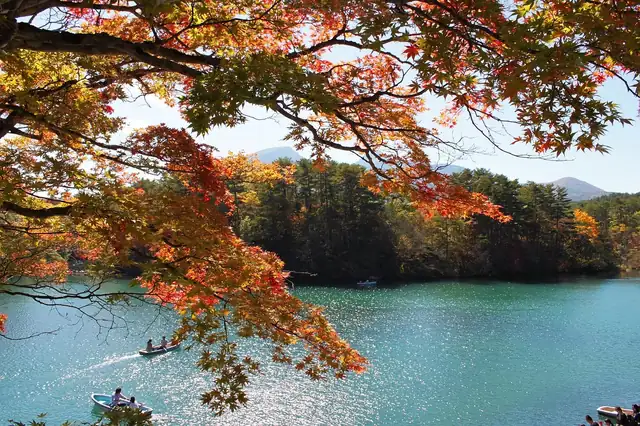 磐梯
磐梯 秋田
秋田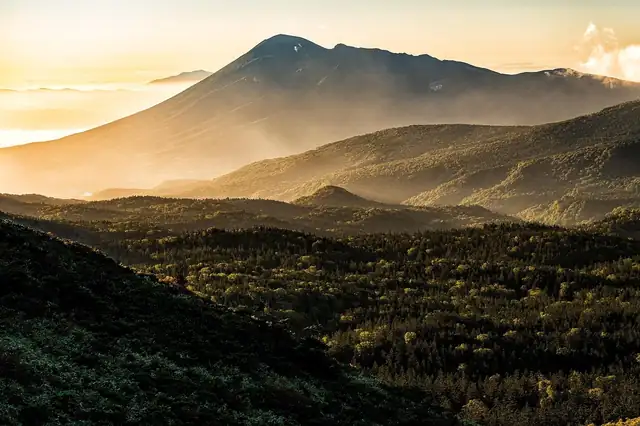 岩手
岩手